
How to Find the Best Local Businesses in Any City
Let’s take a moment to reflect on this: 82% of mobile searchers do “near me” searches, but chances are most of them are visiting businesses that simply know how to work the system but don’t deserve the recognition. This imbalance between the top of the list and the best of the bunch is what’s wrong. And it’s a bigger deal than you’d think. Whether you’re moving to a new city, you’re on the road for work, or you’ve been living in one place for years but still feel like you’re rolling the dice when you need to find a good local service this is a simple process for finding the businesses in your community that are worth your time and money.
Why the First Result Is Rarely the Best One
Search engines are not quality filters. They are authority and relevance filters and these aren’t the same.
A business appears at the top of a search result because it has good local SEO, a good Google Business Profile, good NAP (name, address, phone number) citations across the internet and, hopefully, it has also spent some money on it. Those things do not reflect whether the restaurant’s food is delicious, the contractor is punctual or the hair salon follows your instructions.
It’s the companies that invested in online marketing (as opposed to the product or service) that make the cut for the results page. Meanwhile, the barbershop three blocks away that’s been cutting hair in the same spot for 19 years, with a loyal neighborhood following and zero social media presence, sits invisible on page four.
That’s the first thing to remember: search results are not the place to find great local businesses.
Search Smarter Before You Search Harder
But don’t worry, search engines are still essential you just have to use them in a different way.
No more broad searches. “Best restaurants near me” is the most idiotic search you can do. Instead, use: type of business + name of neighborhood + name of city. “Italian restaurant Wicker Park Chicago” or “family dentist Midtown Atlanta” returns results that have spatial specificity embedded in their web presence which already weeds out some of the irrelevant businesses.
Once results appear, treat the Google Business Profile like a document to investigate, not a summary to glance at. Look at the number of reviews before the rating a 4.3 rating with 400 reviews is a far better option than a 5.0 with 14 reviews. That near-perfect score with minimal volume is one of the clearest signs of review manipulation in local search.
Check out the photos. Owner photos are marketing. Customer-uploaded photos are reality. The gap between those two sets of images tells you more about a business than any written description ever will.
How to Read Reviews Without Getting Fooled
The wrong way to read reviews They look for the general rating, see if the bad reviews are reasonable, and then they’re done. This leaves you open to mediocre businesses that you don’t immediately recognise as such.
Read specifically for repeat visit language. Things like “I’ve been going here for years,” “every time without fail,” or “my family and I go here now” are the most important things to look for in reviews. These tell you the business has achieved customer loyalty which is based on consistency, and consistency is difficult for low quality businesses to maintain.
Look for when people are named. “Ask for Diana at the front desk” or “the technician Marco walked me through everything” signals that the business has built genuine personal service relationships not just transactional ones.
Pay close attention to how management responds to negative reviews. If a business responds to a complaint, explains and then reconcilies without becoming defensive you know how it will respond in a difficult situation. It’s the business that will respond responsibly if you have trouble and it’s inevitable that you have trouble somewhere.
Look at at least two sites. Google, Yelp and Facebook each have their own forms of gaming. If the business has a good reputation across all three, it has earned it the old-fashioned way through sufficient customer experiences to counter the manipulation.
Your Neighborhood Has Better Answers Than Google Does
Nextdoor and local Facebook community groups are the most underused local business research tools available right now and they’re sitting on most people’s phones already.
When someone in your neighborhood asks “who does the best tile work around here?” the responses that follow come from verified residents who have zero financial stake in the answer and will run into that same neighbor at the school pickup line next week. That social accountability makes these recommendations categorically more reliable than anonymous online reviews.
The specificity you get in these spaces is also unmatched anywhere else. Not just a business name but “call and ask for the owner directly, the front desk books you with whoever’s free,” and “they’re backed up three weeks but worth the wait.” That level of local insider knowledge takes a search engine years to approximate, and it still won’t get there.
Search the group before you post. Most active local community groups have years of archived recommendations sitting in their search history, organized by category, full of genuinely useful detail from people who have actually used the service.
City Subreddits Tell You What People Actually Think
Every major American city has an active, opinionated subreddit. r/Boston, r/LosAngeles, r/Nashville, r/Portland these communities are filled with longtime residents who have strong, specific opinions about local businesses and no reason to soften them.
Planted recommendations and fake reviews get identified and called out fast in these spaces. The upvote system surfaces the most credible, useful responses naturally. And because the community is large and anonymous, the feedback is honest in a way that even Yelp often isn’t.
Before posting your own question, run a search inside the subreddit for your business category. “Best mechanic north side” or “reliable property manager recommendations” these threads exist, they’re detailed, and they reflect real community consensus built from actual experience rather than star ratings.
The Bottom Line
Great local businesses aren’t hidden. They just get buried by paid links, enterprises that game the system, and the general information pollution of a search engine that favours online marketing dollars over quality. The system that actually works is simple: search with geographic specificity, investigate business profiles like a researcher, read reviews for loyalty signals rather than sentiment, and pull from community sources where real accountability exists. Stack those layers and you stop guessing entirely.
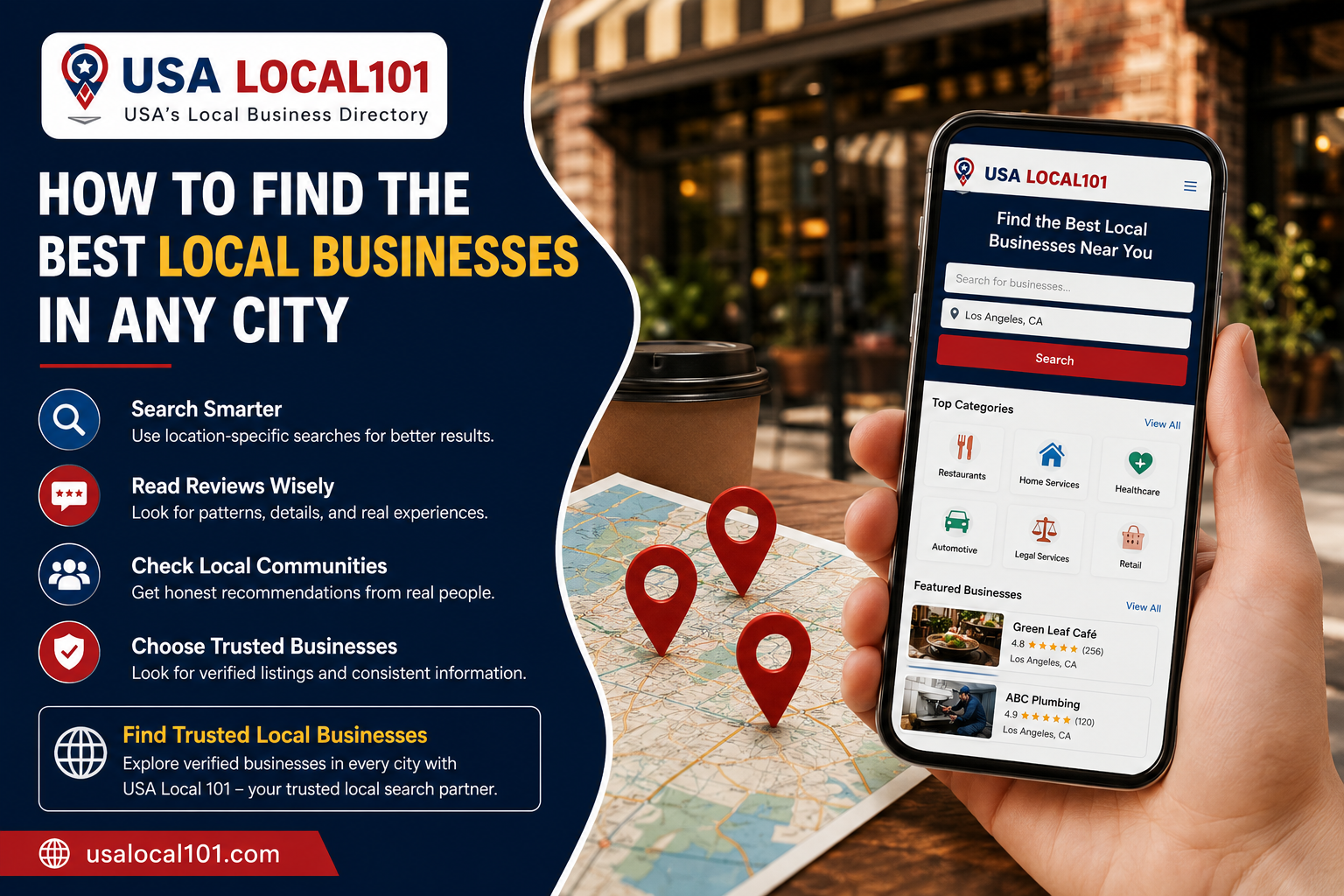
For those times when you need to find something quickly when you’re new to the area, or don’t have time, or just want something better than average there’s USA Local 101. It’s a local search engine that prioritises verified businesses and community trust, and presents them by city and category – so your first search result is already better than 95% of the people that spend an hour scouring search engines. Begin with that, and then go deeper with the information in this guide.
Recent Posts
Top 5 Reliable Gas Line Installation Services in Roanoke, TX
5 Best Slab Leak Detection & Repair Services in Keller, TX