
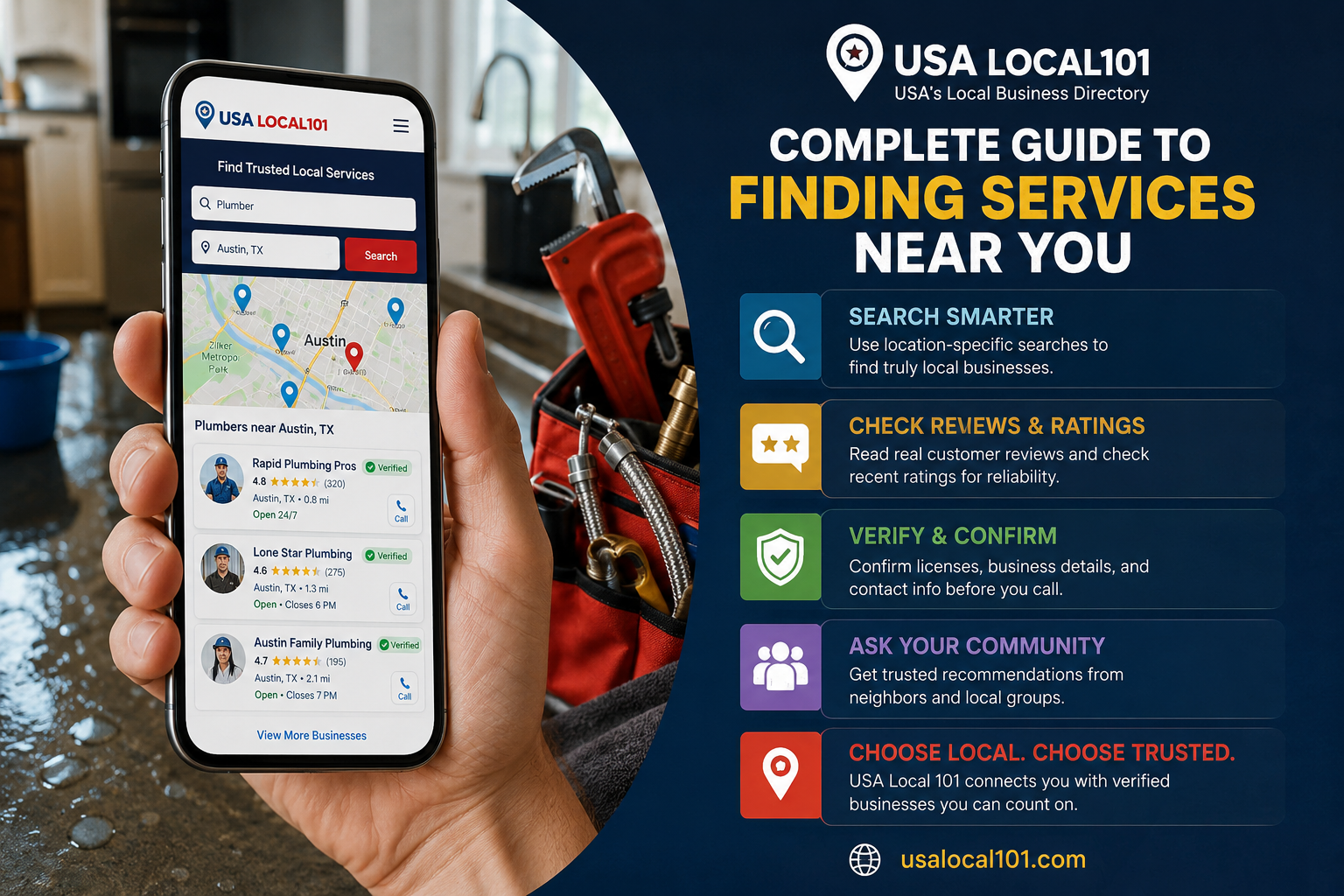
Complete Guide to Finding Services Near You
Imagine if you needed a plumber at 11 PM on a Sunday, there was a flood in the kitchen and the results for all your Google searches were for plumbers in a city three hours away? It’s not hypothetical it happens to thousands of Americans every week. It’s easy to find local service providers, unless you are searching for them and combing through irrelevant search results, non-functional phone numbers and businesses that haven’t been operating in your area in years. Local service discovery has come a long way but most people still use archaic techniques that are slow and inefficient. This guide fixes that.
Why “Near Me” Searches Fail More Than They Should
Every month in the US, billions of searches are made for “services near me”. But the results are notoriously inconsistent. You might see the #1 search result that advertises a local phone number but is really a call center that forwards the call to a contractor in a nearby county.
This is because Google’s local search algorithm is based on relevance, proximity and prominence. So a well-reviewed electrician located a few blocks away can outrank one across the street. Understanding this dynamic changes how you search.
Rather than search “electrician near me” search “electrician + your neighborhood + city name”. This helps Google weights the search query as location specific. You will get very different results and see businesses that are actually located on your street, not those that just claim to be.
The Right Way to Use Google Maps for Local Services
Few people use the world’s best local search engine to its full potential. Here’s how to make the most of a search on Google Maps:
Filter by both rating and hours. Once you have done a search, click the filters at the top and select a minimum of 4.0 stars and “Open Now”. That will take out around 60% of the junk results.
Take note of the review dates. 4.8 stars may be impressive for a business but if the last review was written 14 months ago it tells you the business has changed. Recent reviews in the past 90 days indicate whether the business is still as good. Quality drops. Staff changes. Ownership transfers. A review from last Tuesday is worth ten reviews from 2 years ago.
Look for a “Questions & Answers” section. It’s hidden under most businesses but contains valuable information past customers asking if the service is offered in a particular zip code, if an appointment is necessary or what the average wait time is. Unfiltered, unspun information the business doesn’t control.
Look at customer uploaded photos, not business. Business photos show the best. Customers’ photos show what it looks like and sometimes red flags around cleanliness, professionalism or quality of work.
Local Directories That Actually Work
In addition to Google, there are a handful of local service listings that are worth knowing about not so much as marketing channels, as verification services that eliminate scammers.
Yelp remains effective for service businesses in dense urban areas. Its review filter is controversial, but does a pretty good job at weeding out fraudulent reviews. In places like Chicago, Houston, Los Angeles and New York, Yelp’s local listings are rich and constantly refreshed.
Angi (formerly Angie’s List) is geared towards local services heating ventilation air conditioning (HVAC), roofers, landscapers, plumbers, electricians. It’s helpful because the service professionals on the site are subject to background checks, and the company confirms that reviews are from the people who booked an appointment through the website.
Thumbtack is a different model you create a job and service providers will contact you. This is great if you need a particular service – a photographer, a personal trainer, a tutor, an event coordinator – and you need to quickly compare options without calling a dozen different people.
NextDoor is underestimated. Your neighbors have already vetted local services through direct experience, and their recommendations inside the platform carry a weight that no algorithm can replicate. When Joe from down the street says to “ask me for my roofing guy,” that’s about as close as you can get to a real-life personal recommendation.
Verifying a Local Business Before You Call
Finding a business is step one. Verifying it’s legitimate and competent is where most people skip corners and pay for it later.
Check their physical address on street view. Paste the business address into Google Maps and switch to Street View. A legitimate local contractor should have a real storefront, office, or vehicle yard visible not a residential home they’re using as a fake business address to game local SEO rankings.
Verify licensing through your state’s official database. Every U.S. state maintains a public database of licensed contractors, healthcare providers, legal professionals, and other regulated industries. Search “[your state] contractor license lookup” and cross-reference the name or license number the business provides. A licensed HVAC technician in Texas, for example, must be registered with the Texas Department of Licensing and Regulation and that’s publicly searchable in seconds.
Call during business hours and ask one specific question. Don’t ask “are you available?” Ask something operational: “What’s your typical response time for a same-day appointment?” or “Do you carry liability insurance for jobs over $5,000?” How they answer not just what they say tells you a great deal about how professionally the business operates.
Service Categories Where Hyper-Local Matters Most
Not every service requires this level of scrutiny. But for certain categories, hyper-local availability is the difference between getting help and not getting it at all.
Emergency home repair services burst pipes, gas leaks, electrical faults, storm damage require someone who can physically arrive within an hour. A business 45 miles away advertising “24/7 emergency service” is not the same as a licensed plumber three miles from your house.
Medical and dental services particularly urgent care clinics, walk-in dental offices, and physical therapy centers need to be close enough that you’ll actually go when you need to. Insurance networks further complicate this, so always cross-reference the provider directory from your specific insurance carrier alongside any local search.
Legal services specifically family law attorneys, estate planning lawyers, and criminal defense representation benefit significantly from local practitioners. Local attorneys know the specific judges, local court procedures, and regional legal culture in ways that a national firm with a satellite office simply doesn’t.
Child and senior care services daycare centers, in-home care providers, memory care facilities require not just proximity but a level of personal vetting that directories alone can’t provide. State licensing records, inspection reports, and direct facility visits are non-negotiable.
When Local Search Fails, Go to Community Sources
If you’re still looking after searching and browsing directories, you may find unadvertised gems in community resources.
Recommendations in local Facebook groups, local city subreddit threads (look for “r/[yourcity]”), or local newspaper articles about your neighborhood association are all from people who have no financial stake in making referrals. These are the “hidden-gem” businesses the independent appliance repair person who’s been in the same local area for 22 years and who doesn’t need a website because he gets referrals for all the work he can manage.
Your local Chamber of Commerce also maintains member directories of verified local businesses across nearly every service category. It’s old fashioned but it works and Chamber membership means at least that the business is committed to its local reputation, to the point of paying for these affiliations.
Putting It Together
The difference between a frustrating local search and a productive one comes down to specificity, verification, and knowing which tools actually serve the purpose you need. Don’t use only one directory. Cross-reference what you find. Check licenses. Read recent reviews. Call and ask questions.
If you’re looking for a good place to start to find verified local service providers in a range of categories from plumbing and heating repair to legal services to medical services USA Local 101 is designed to help U.S. residents find local businesses they can trust in their local communities, with a particular emphasis on verified listings that have been checked to ensure legitimacy and service quality.
Recent Posts
Top 5 Reliable Gas Line Installation Services in Roanoke, TX
5 Best Slab Leak Detection & Repair Services in Keller, TX