
Local Search Trends: How People Find Businesses Online
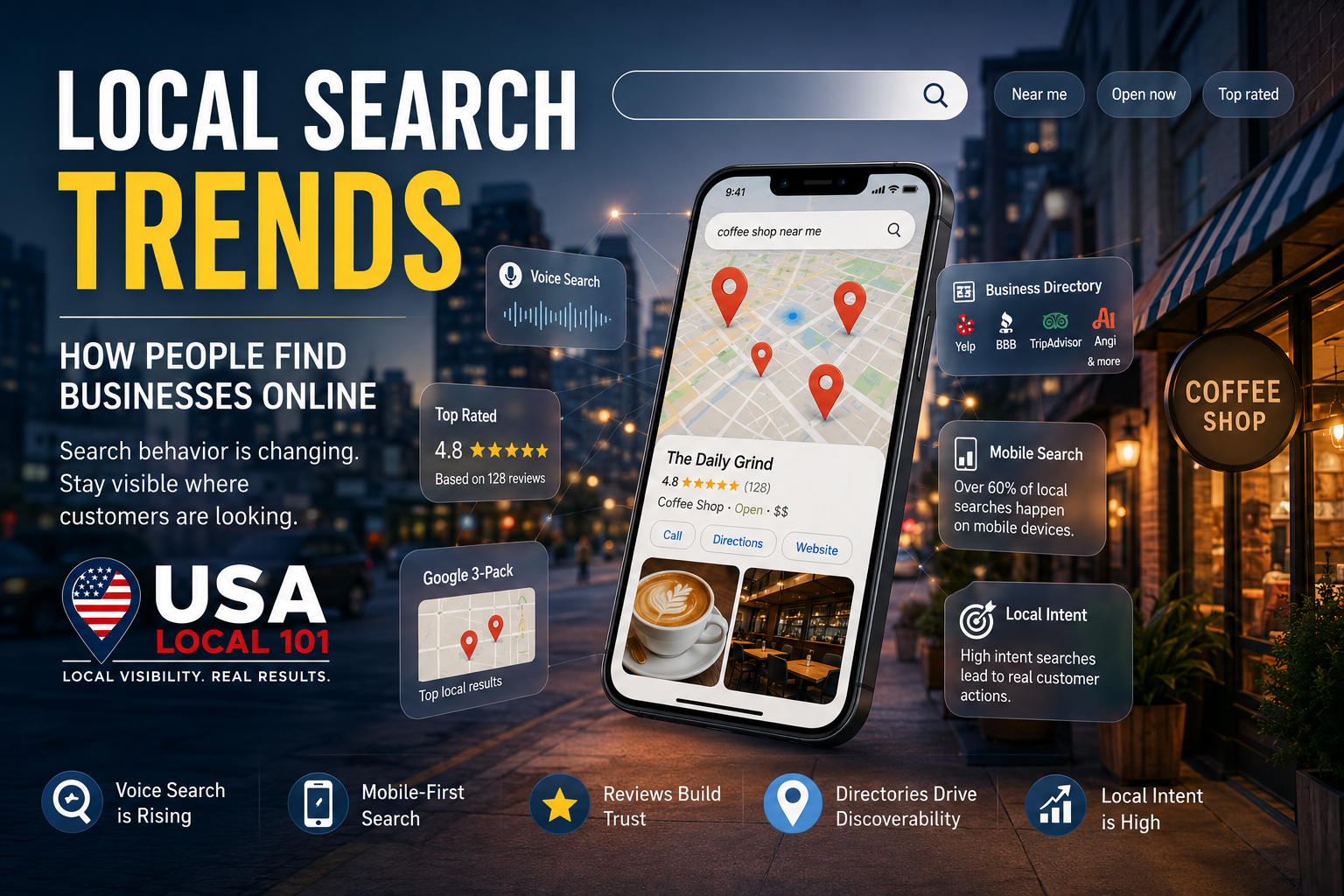
In the past year, the internet was used by 93% of consumers to find a local business and how they’ve done so has changed. Say goodbye to making a search for “pizza near me” in a desktop browser. Today’s local search behaviour is faster, more voice-driven, more visual and more intent-driven than ever before. Your business is not only missing these changes, it is invisible.
The “Near Me” Revolution Has Grown Up
The phrase “near me” became a cultural shorthand for local intent, but it’s evolved far beyond those two words. Search queries have become dramatically more conversational and hyperlocal. Instead of “dentist near me,” users now search “affordable family dentist open Saturday in downtown Austin.” This reflects a fundamental shift in how Google’s local search algorithm processes intent it’s no longer just about proximity, it’s about relevance, prominence, and behavioral signals combined.
Google Business Profile (GBP) formerly Google My Business sits at the center of this ecosystem. Businesses with fully optimized GBP listings, including updated hours, service categories, photo libraries, and responses to reviews, consistently dominate the local 3-pack the three map-based results that appear before organic listings. These three spots capture the majority of clicks for local queries, making GBP optimization not optional but essential.
What’s notable here is that Google’s algorithm for local ranking weighs NAP consistency (Name, Address, Phone number) across directories heavily. A business listed as “Joe’s Plumbing LLC” on its website but “Joes Plumbing” on Yelp creates a trust gap that suppresses rankings. This is a granular, technical reality one that many small businesses completely overlook.
Business Directories: The Backbone of Local Search Visibility
Most business owners consider online directories to be a thing of the past. This is not the case. One of the most effective and yet underutilized, local search elements, is business directory listings and the businesses that control them are the ones that are subtly taking over their local market.
The process is simple: If your business appears in the right places and consistently, Google interprets that as a sign of trust. It is the search engine’s method of ensuring that your organization is legitimate, legal, and that it’s in the place and operating under the name that you’re stating.It is the search engine’s way of ensuring the legitimacy of your business, its legality, and that it is at the location and runs under the name you are claiming. Generally, the more important the directory, the more powerful the signal.
The Directories That Actually Move the Needle:
- Yelp remains the biggest restaurant, home service, and health review and discovery service, with its domain authority directly influencing local pack rankings.
- The Better Business Bureau (BBB) accreditation and listing here indicates trustworthiness and credibility, especially for businesses that provide a service to older people.
- Angie’s List, a home services marketplace, is essential to contractors, plumbers, electricians and home service providers; leads created here have a high purchase intent.
- Houzz is the top directory for interior designers, architects and home renovation businesses; niche authority is greater than a general listing.
- For medical professionals, Healthgrades, Zocdoc, and Vitals are essentials; patients look at these sites without relying on Google!
- TripAdvisor is the must-have tool for hospitality, tourism companies and food businesses; its review system impacts on search engine rankings and booking decisions.
- Apple Maps, Bing Places – huge underutilized! Apple Maps is used in Siri’s local results and Bing is used in a lot of voice search on Alexa devices.
- Facebook Business Pages act as a virtual directory with reviews, hours and location information that Google actively crawls.
What Makes a Directory Listing Work:
There are only three things that make the difference between a directory listing that can help your rankings, and a directory listing that doesn’t do anything. The first one is category precision – selecting the most specific business category you can, rather than a general “umbrella” term. Second, the quality of the description in your actual services (as natural-language phrases) not the level of keyword stuffing. Third, photo consistency, uploading the same main directory or logo image to the same directories to help Google’s image recognition system to associate them with one verified storefront.
One of the best ROI local SEO activities you can undertake is citation building which involves getting your business on the map of the relevant directories. There are tools, such as Moz Local, BrightLocal and Yext, which can help automate this, but it is important to audit the existing citations for errors at least twice a year.
Voice Search Is Reshaping How Queries Are Formed
Voice search optimization isn’t just a future idea anymore, it’s a necessity in this day and age. The fundamentals of local search queries have completely shifted with more than 35 percent of American households having a smart speaker and mobile voice assistants being used every day by billions. The queries that are voiced are longer, are structured as complete questions and are significantly more likely to have immediate commercial intent.
People typing might look up “Italian restaurant Chicago. When they talk, they ask “Hey Google, what are the best Italian restaurants near me that book up tonight?” The difference is important because:
- Voice assistants read aloud feature snippets and Position Zero. Therefore, it is important to have structured content that addresses questions.
- LocalBusiness schema: This type of schema provides search engines with precise details about your business, such as its location and services, which helps to ensure that voice search results are accurate.
- The increase in queries has been significant, especially those that include “open now,” “near me,” and “today,” which require real-time business data, such as hours of operation, to be accurate and up-to-date, across all platforms.
Review Ecosystems Are the New Word of Mouth
The word of the neighbor has been replaced with online reviews. However, with reviews and their impact on local search, it’s not just a matter of adding up the number of stars. Google’s algorithm processes review content. Overall, a plumbing company with numerous reviews that talk about “emergency leak repair” or “water heater installation” receives an indirect keyword signal boost for plumbing emergency leak repair and water heater installation services.
The rate of return on the review is also important. Google’s quality evaluators look for businesses that respond to 100% of reviews, positive or negative, and exhibit E-E-A-T signals (Experience, Expertise, Authoritativeness, Trustworthiness). A well-crafted response to a negative review that acknowledges the issue, offers resolution, and signs off professionally actually builds more trust than a business with only glowing reviews and zero engagement.
Each of the following websites has a domain authority and contributes to a business’s local search visibility: Yelp, Tripadvisor, Facebook Reviews, and industry-specific sites such as Houzz for home, or Zocdoc for healthcare. You’ll miss out on valuable local SEO equity by not leveraging these platforms as well as Google.
Social Search and the Instagram/TikTok Discovery Layer
Most of the traditional local SEO guides won’t tell you this: Gen Z and younger millennials are searching for local businesses on TikTok and Instagram. You can see that there are searches such as “best brunch spots Los Angeles” or “hidden gem coffee shops NYC” occurring in huge numbers on social networks, well off Google’s radar.
This new discovery channel is called user generated content (UGC), check-ins, location tags, and short-form video reviews. A restaurant appearing in an organic TikTok video from a food creator with 200K followers can drive more foot traffic than a month of Google Ads spending. It’s social proof on steroids, and it’s a positive ranking factor for local search, too, because more brand searches on Google due to social discovery are a local search ranking factor.
Conclusion
Local search is no longer a channel, but a tightly woven network of Google Business Profile optimization, business directory listings, voice search, mobile intent patterns, review ecosystems, hyperlocal content strategy, and social discovery. If companies consider these as individual measures, they will never be able to perform as well as companies that combine these in a coherent strategy for local digital presence.
The companies that are going to have success in local search for 2025 and beyond are those who see the big picture, who appear in the local 3 pack, can be found by voice, have perfect NAP consistency across all directories, and attract real trust by responding to reviews and adding content to the community.
When it comes to expert guidance on all of this, USA Local 101’s mission is to help businesses dominate local search results, and not leave it up to chance.
Recent Posts
Top 5 Reliable Gas Line Installation Services in Roanoke, TX
5 Best Slab Leak Detection & Repair Services in Keller, TX