
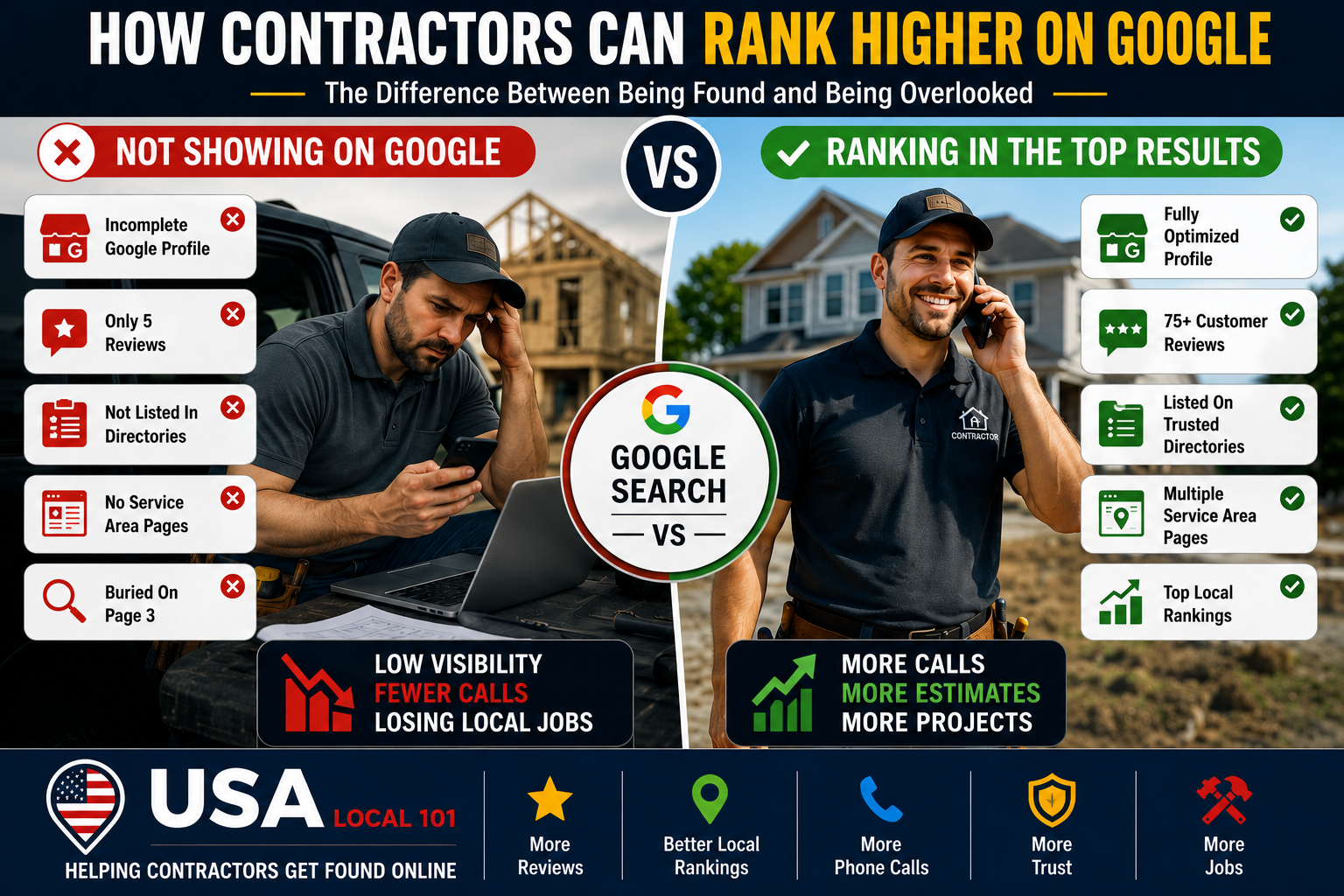
How Contractors Can Rank Higher on Google
Last summer you constructed a perfect deck. The homeowner raved, took in some photos, and informed their neighbors, but when their neighbors searched Google for “deck contractor near me” your competitor 3 towns away showed up on top. You didn’t. That job went to someone else.
This is the situation for thousands of qualified professionals in the construction industry throughout the United States. Google has become the new word-of-mouth, and if you’re not showing up in the top results, you’re invisible to the customers who are actively looking to hire someone like you right now. The good news? Owning a higher rank on Google is not a magic trick, it’s a strategy followed on a regular basis. Here are the steps you’ll need to follow.
1. Claim and Optimize Your Google Business Profile Completely
Out of all the things a contractor can do to facilitate their local search visibility, this is the one that could have the greatest effect and is most often done halfway.
If you don’t already have a listing for your business on Google, go there and claim it. Next, complete all fields, don’t only provide your name, phone and address. These are the things that most contractors miss out on:
- Service areas: Google lets you specify up to 20 service areas. If you’re a roofer from Columbus, Ohio, include nearby cities such as Westerville, Dublin, Hilliard, and Grove City. The more you add, the more likely you are to be seen in local searches from those areas.
- Services: Don’t mention just “roofing” but specify each and every service you provide: “asphalt shingle roof replacement, emergency roof repair, gutter installation”. These are used by Google to correlate your profile that you look for.
- Category for business: Select the most specific primary category as possible. It always outshines “Contractor” with its “Roofing Contractor!” title. Include 2nd categories as well.
- Photos: upload at least 20 good quality photos of the real jobs you’ve completed. Google’s algorithm prefers profiles that have modern, fresh pictures and photos. On Google Maps, the businesses that have images get 42% more requests for directions.
Keep business hours current, particularly during holidays. Inaccurate hours hurt your ranking and your credibility.
Use the “Posts” feature on your Google Business Profile to post once a week a project completed, a seasonal promotion, or a quick tip. Google rewards active profiles.
2. Get More Google Reviews and Respond to Every Single One
Google’s local ranking algorithm weighs three things heavily: relevance, distance, and prominence. Reviews are one of the biggest drivers of prominence.
Here’s a concrete system: After every completed job, text the customer a direct link to your Google review page. Don’t email text. Text messages have a 98% open rate compared to around 20% for email. Your message can be simple: “Hi [Name], it was great working with you! If you have 2 minutes, we’d really appreciate a Google review it helps us a lot. Here’s the link: [URL]”
Aim for a minimum of 25 reviews before you expect strong local ranking. Contractors with 50–100 reviews in a specific city consistently outperform competitors with fewer reviews, even if those competitors have been in business longer.
Respond to every review positive and negative. When you respond to a negative review professionally and offer to make it right, Google sees engagement and potential customers see integrity.
3. Build a Website Optimized for Your Specific Trade and Location
A Facebook page is not a website. A website built by your cousin in 2014 with no updates is barely better. Your site must do certain things to get ranked:
Have individual service pages: not one page that lists everything under Our Services. Create a unique page for each service with each having its own target keyword – bathroom remodels, kitchen remodels, basement finishing, etc. So a page that has 600+ words of legitimate, helpful information will beat a services page every time.That’s why a page with 600+ words of actual and helpful information will beat a services page every time.
Include local specific keywords in your content: If you are working in a specific location, try using phrases such as “licensed electrician in Denver, Colorado,” “HVAC installation in Charlotte, NC,” or “fence installation contractor in Sacramento.” Google requires geographical signals to determine location.
Ensure that your site performs well on mobile: More than 60% of home service searches in the U.S. are conducted on a mobile device. Use Google’s free PageSpeed Insights tool (pagespeed.web.dev) to check your site speed. Google penalizes any site that loads in over 3 seconds and with that, you’re losing rankings and customers.
Place NAP (Name, Address, Phone Number) on each page: Consistency matters enormously. Google is being confused by any discrepancies that are found, such as if your Google Business Profile says “Ave”, and your website says “Avenue.
4. Get Listed in the Right Online Directories
Google looks at external websites to verify that your business is legitimate and established. This is called citation building, and for contractors in the U.S., the following directories are the most important:
- Angi (formerly Angie’s List)
- HomeAdvisor
- Houzz (especially for remodeling and interior contractors)
- Yelp
- Thumbtack
- BBB (Better Business Bureau)
- Bing Places for Business
- Apple Maps
Make sure your business name, address, and phone number are identical across every single one of these platforms. Even small inconsistencies a suite number on one listing but not another can dilute your local SEO authority.
5. Build Local Backlinks Not Just Any Links
A backlink is when another website links to yours. Google treats backlinks as votes of trust, and local backlinks carry extra weight for local rankings.
Here’s how contractors can get real, local backlinks in the U.S.:
- Supplier and manufacturer websites: If you’re a certified installer for brands like GAF, CertainTeed, or James Hardie, those companies often have “find a contractor” directories. Get listed those are high-authority backlinks.
- Local Chamber of Commerce: Most U.S. cities and towns have a Chamber of Commerce with a member directory. Annual membership typically costs $150–$500 and almost always includes a website listing with a backlink.
- Local news sites and blogs: Sponsor a local youth sports team, donate to a charity, or complete a pro bono project for a nonprofit. Local news outlets often cover these stories and link to your website.
- Subcontractor relationships: If you work with other trades regularly plumbers, electricians, painters ask to exchange links on each other’s websites. It’s free and mutually beneficial.
6. Use Structured Data Markup on Your Website
This is a step that most contractors don’t even think about – and it is an opportunity. Structured data (also known as schema markup) is a code that you place on your site that tells Google what your business is, what you provide, and where you provide it.
Local Business, Service and Review schema are the most valuable types for contractors. This code is available free from Schema.org or via a tool such as Google’s Structured Data Markup Helper. You can add this to your site without coding if you use WordPress with plugins such as RankMath or Yoast SEO.
With the right schema markup, contractors can be eligible to show up in Google’s rich results – these listings are more visually appealing than standard blue links and include details such as business hours, service areas, star ratings, and so on.
Conclusion
The secret to being a #1 contractor in the United States is performing certain, unglamorous tasks repeatedly, taking full advantage of your Google Company Profile, having a review collection strategy, establishing location pages for services, and getting the right local backlinks. It’s not a miracle. Most contractors will begin to see significant ranking improvements in 90-120 days after they begin using these strategies seriously.
For those who don’t know where to begin or prefer to concentrate on their trade while the digital side of things is dealt with by the professionals, USA Local 101 is a specialist in helping contractors in the United States get discovered online. They know how local seo is and they can create and implement a strategy tailored to your service area, competition, and goals. For contractors serious about growing through Google, they’re worth a conversation.
Recent Posts
Top 5 Reliable Gas Line Installation Services in Roanoke, TX
5 Best Slab Leak Detection & Repair Services in Keller, TX