

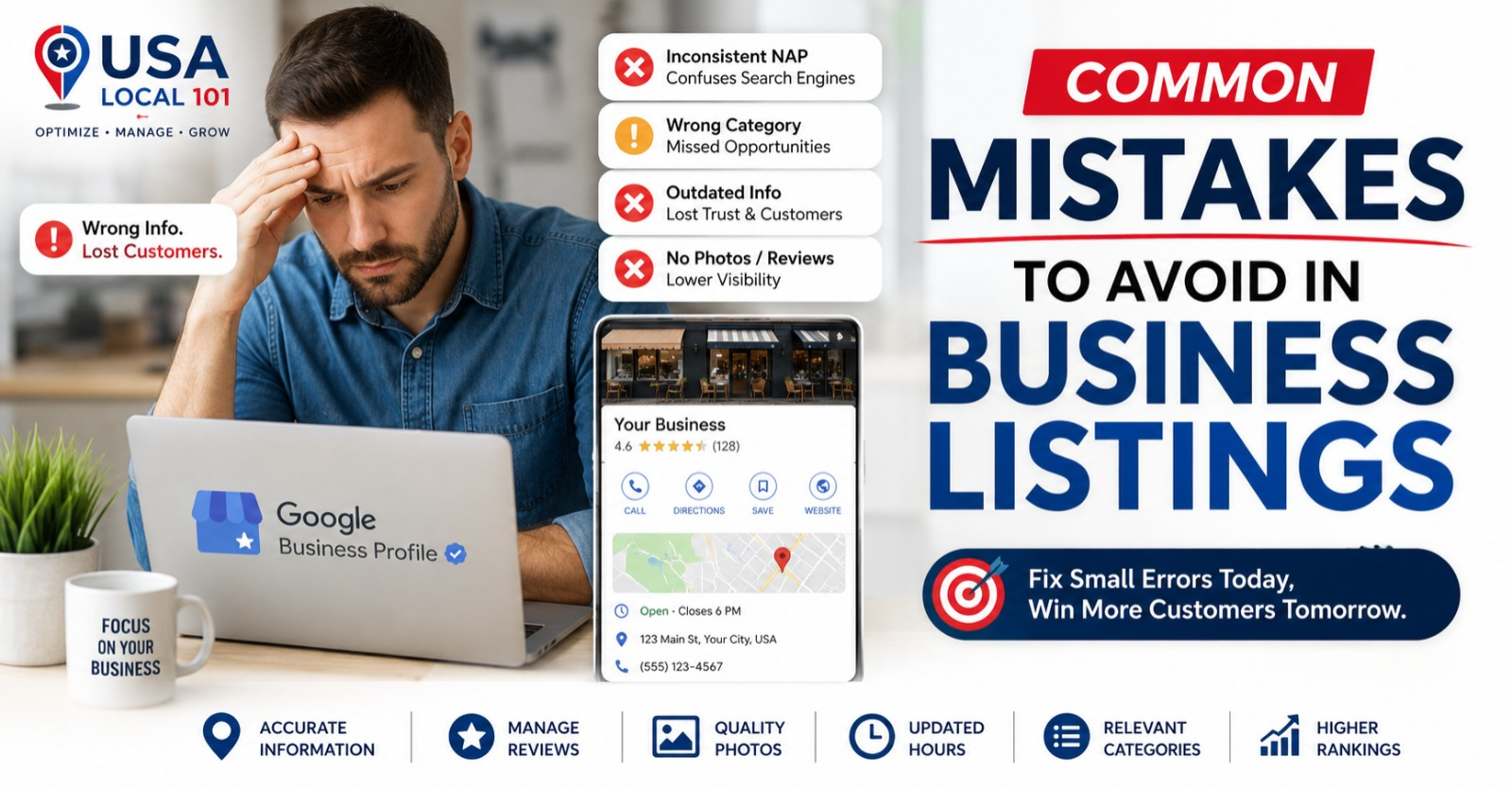
Common Mistakes to Avoid in Business Listings
Your Google Business Profile is your most valuable salesperson or your most costly mistake and the sad reality is that most business owners just don’t know. At this moment, someone in your neighbourhood is looking for the product or service you provide. They found your local listing. But your phone number is off by one number. Or your hours indicate you close on Saturday, but you are actually open. Or your address is the one you moved out of 18 months ago. That customer did not call to verify. They did not dig deeper. They clicked on the next page and paid their money to the competitor who listed the correct information. This is not a marketing gap or a branding issue. It is a business listing problem specific, fixable, and costing you far more than you realize.
Inconsistent NAP Information Across Platforms
The biggest, most costly mistake a business can make is inconsistent Name, Address, Phone Number (NAP) data. Your company could be listed as “ABC Plumbing LLC” on Google Business Profile, “ABC Plumbing” on Yelp, and “A.B.C. Plumbing Services” on Bing Places. To a person, this looks like the same place. To a search engine bot as it crawls the citation sources, they appear to be three different businesses none of which can be trusted completely.
- This directly affects your local pack rankings. Google matches your NAP data with dozens of citation sources, including:
- Google Business Profile, Yelp and Bing Places the main directories most businesses are aware of
- Foursquare and Apple Maps which provide location information to hundreds of apps
Data aggregators such as Data Axle and Neustar Localeze which automatically feed your business data to thousands of micro-directories
When these signals conflict, Google reduces its confidence in your listing and ranks you lower in map pack results. Just fixing the listing isn’t enough. You need a citation audit pulling every instance of your business name across the web and standardizing the format down to whether you write “Street” or “St.” That level of precision matters.
Choosing the Wrong Business Category
In choosing their primary category, many business owners go for the most noble sounding category rather than the most relevant one. A dentist who lists themselves under “Medical Center” instead of “Dentist” is making a critical error. A Mexican restaurant that chooses “Restaurant” instead of “Mexican Restaurant” is leaving hyper-targeted local search traffic on the table.
Google Business Profile categories are the key to which search queries your listing shows up for. If you have a kids’ dentist, your primary category should be “Pediatric Dentist” not “Dentist”. The more specific, the more relevant the searches.
Secondary categories matter equally. A personal injury law firm should include secondary categories such as “Legal Services” and “Personal Injury Attorney”. This layered category structure expands your search visibility without diluting your core positioning. Businesses tend to focus on a single category and wonder why they’re losing visibility for some of their targeted searches.
Uploading Low-Quality or Outdated Photos
A listing with no photos or worse, blurry, dark, or irrelevant photos communicates one thing to potential customers: this business does not care about its presentation. Google’s own data confirms that listings with photos receive significantly more direction requests and website clicks than those without.
The mistake is not just having bad photos. It is also neglecting photo updates over time. If your storefront was renovated two years ago but your listing still shows the old exterior, customers will not recognize your location when they arrive. That creates confusion, distrust, and in some cases, negative reviews blaming you for misleading them.
For service area businesses, photos of your team, vehicles, and completed work build E-E-A-T (Experience, Expertise, Authoritativeness, Trustworthiness) directly into your listing. A plumber who shows before-and-after pipe repair photos is demonstrating real experience. That visual proof converts browsers into callers faster than any headline.
Ignoring the Business Description Field
Your business description gives you 750 characters, which you can use to write a description or a mission statement like “We are a family-owned business dedicated to serving our community.” That’s not saying anything.
A good one will include the services offered, the areas you service, how long you have been in business and, of course, local keywords without being spammy. “We have installed licensed HVAC and repaired emergency air conditioners in the Phoenix metro area since 2009” is more useful to your customers and to local search algorithms than a mission statement.
This is also a place to bolster trust signals. “Certified by ABC”, “Membership in XYZ”, and “Awarded Best of City” are all reasons for search engines and customers to select you over a competitor with the same star rating.
Not Managing Duplicate Listings
Most businesses have more than one Google Business Profile listing (and it’s not good). They are usually caused by:
- The previous owner made a listing that was never claimed or deleted when the owner changed
- The business moved and the previous address listing was not removed or closed
- An employee accidentally created a second profile during a rebranding or website update
The consequences compound quickly. They divide your review capital customers may write glowing reviews on the wrong listing. They cause confusion for Google’s local algorithm. They can also display different operating hours and address information, which leads to lost revenue from missed customers.
The solution for duplicate listings is to claim the listings, and then request a merge from Google Business Profile support. It is tedious, but it is not optional. A business with 47 reviews on one listing and 23 on a duplicate is effectively running two half-strength profiles instead of one dominant one.
Leaving Business Hours Unchecked During Holidays
This mistake is pretty small until a customer turns up at your location over Thanksgiving weekend because your listing shows you’re open, and finds you’re closed. People will likely leave a bad review, noting deceptive hours.
Special hours, holiday closures, and other temporary schedule changes need to be preemptively updated in your listing. Special hours are a feature of Google Business Profile, and if you use it often it shows that your listing is being managed. Being actively managed is associated with a higher local search ranking because it suggests an active business.
This is a particular problem for restaurants, shops and medical offices, which have the most dynamic hours. It takes twenty minutes to set a quarterly calendar reminder to audit your listing hours and defuses a disproportionate level of customer dissatisfaction.
Failing to Respond to Reviews Positive or Negative
Leaving reviews unanswered is not neutral behavior. It sends a very public signal to all potential customers searching for your business that you either don’t know or care about your reviews. Neither interpretation builds confidence.
Responsiveness to reviews affects potential customers’ impression of your customer service before they even reach out to you. When a restaurant owner responds to a one-star review with an actual reason for the poor experience and an invitation to remedy the issue, that response often overshadows the negative impact a review can have. Readers notice the accountability.
Beyond the human perception of reviews, there are review signals such as volume, freshness and whether owners respond to reviews that are part of the local Google algorithms. Businesses that actively engage with reviews tend to accumulate more of them over time because the interaction itself reinforces the habit in customers who see it happening.
Not Utilizing the Products and Services Sections
Most business listings include dedicated fields for products, services, and menu items that go almost entirely unused. A roofing company that enters services, creates more indexable content on their listing – for example:
- “Metal roof installation” is sought out by homeowners looking for durable roofing options
- “Leak repair” targets distressed customers who are looking for immediate solutions
- “Storm damage assessment” targets insurance-related searches not commonly targeted by competitors
Services can be thought of as “content blocks” that can be matched with customers’ queries. This is a huge boon for service firms in competitive markets. While competitors have a vanilla listing with just a business name and phone number, a full-service listing with services, photos, a compelling description and Q&A feed is like a small website. The more content you can get indexed in that listing, the more searches you can turn up for.
The Real Cost of Ignoring These Mistakes
Every error on your business listing is a leaking pipe in your local marketing funnel. Customers find you, hit a point of friction, wrong number, outdated hours, no photos, confusing address and move on to your competitor who has a cleaner listing. You never see that abandonment. It does not show up in your analytics. It just quietly reduces your revenue month after month. The companies that are succeeding in local search today are not the best businesses. They have the most complete, accurate and well-managed listings. That is a process, not a skill and it’s 100% solvable.
If your business listings need a spring cleaning and a regular management plan, USA Local 101 is an expert in this work citation audits, duplicate listings, category management, and all the other work needed to keep the business listings healthy so that they can drive more calls, more visits, and more customers walking through your doors.
Recent Posts
Top 5 Reliable Gas Line Installation Services in Roanoke, TX
5 Best Slab Leak Detection & Repair Services in Keller, TX