
How Business Directories Help Build Customer Trust
When’s the last time you’ve hired a plumber, picked a restaurant or scheduled a contractor without first looking them up online? If you are anything like the average American, then the answer is never and it’s because of that shift in behavior that business directories are now one of the most important trust-building assets a local business has.
There’s a lot of data to support this. 98% of consumers now search for local businesses online (up from 90% in 2019). They’re not just looking they’re verifying. And the sites they are using to do so? Predominantly, local business listings and review sites. 61% of customers use business information sites, such as Google, Yelp, Tripadvisor, and Better Business Bureau to learn more about a local company they have not visited before or with which they have not done business previously.
What they do or don’t find determines whether they call you or not.
The Trust Gap Most Business Owners Don’t Know Exists
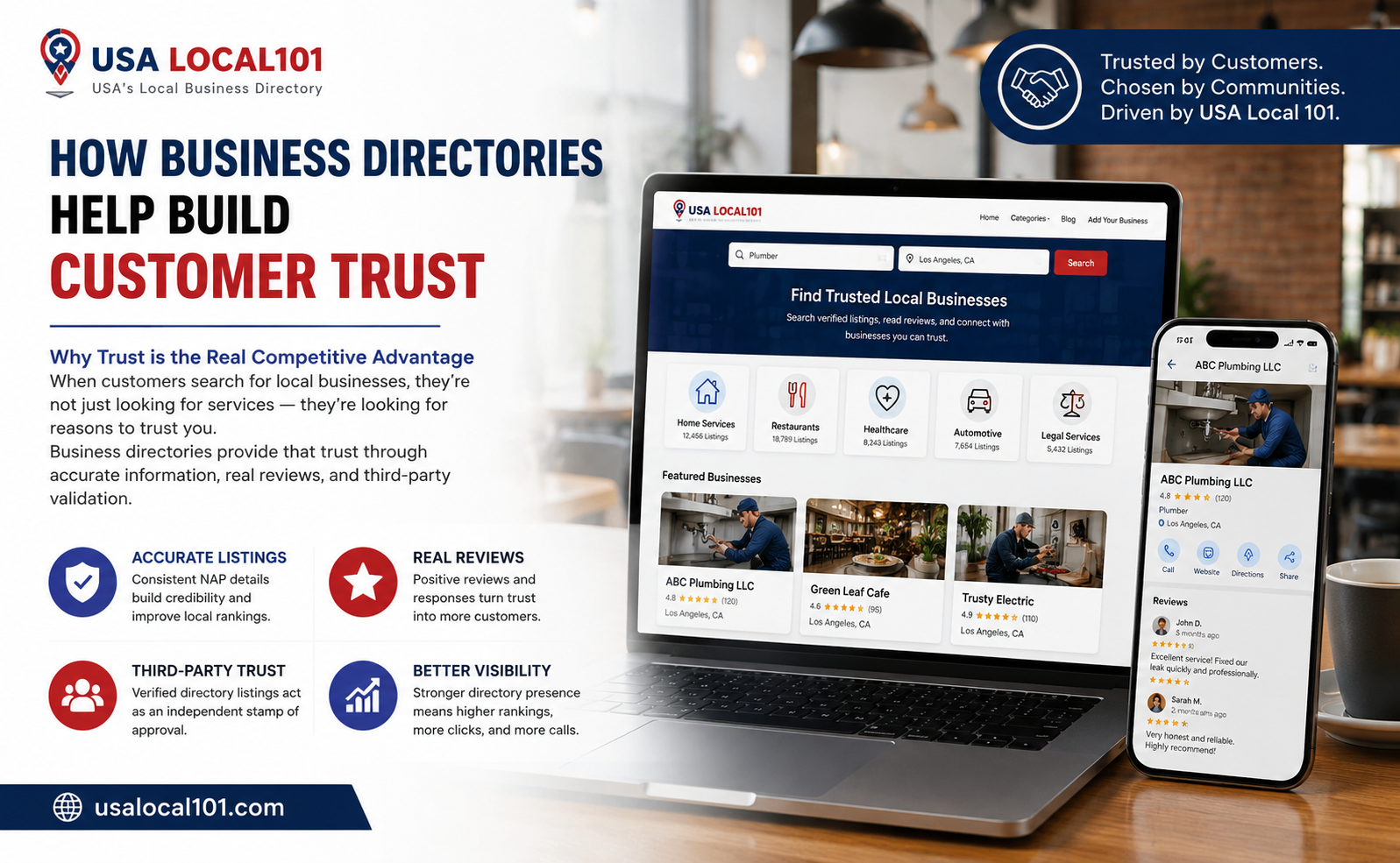
To explain what directories do, we’ll first explain the trust problem. While 90% of business leaders believe their customers trust them, only a few of consumers actually do. It’s not just a perception gap, but a sales gap. A quarter of consumers stop buying from a company because of distrust issues, and many consumers will recommend a trustworthy company to family or friends.
Customers don’t want to be sold your product by your website or your ad. They’re looking for an independent stamp of approval. Business directories are one of the few places where you can get that and do so when the customer is ready to buy.
What Inaccurate Listings Are Silently Costing You
Your Name, Address and Phone Number (NAP) is the core of your online presence. Business owners tend to set it and leave it. That’s a costly mistake.
93% of consumers get upset with inaccurate information on online directories, and 80% say they will not trust the business due to conflicting contact details. Here’s how that plays out: a consumer sees your number on Yelp, calls and it rings out. Or they go to the address you’re listed under and it’s not you. 63% of customers indicated they would not select a business if the information listed was incorrect.
Here’s what it means for your business:
- NAP citations are a local ranking factor (contributing 11% to local search) and Google uses data from business directories to make its “prominence” calculation, which is a significant ranking factor.
- Businesses with consistent NAP details across at least 15 sites are more likely to be in the Google Maps 3-Pack.
- Local map pack businesses receive more website visits and more actions (calls, clicks to website, etc.) than businesses that rank 4-10.
- Customers are 2.7 times more likely to trust and see a business as reputable if they find a complete Business Profile on Google Search and Maps.
- Customers are more likely to visit and more likely to consider buying from a business with a complete Business Profile.
Each inaccurate address or wrong phone number is not only inconvenient, it’s also a lost opportunity to convert a customer to one of your competitors whose data is up to date.
Why Third-Party Validation Outperforms Every Ad You’ve Ever Bought
There’s a reason why a directory listing carries weight that your own website doesn’t. Customers know you built your website. They know you wrote your bio. What they can’t easily fake is a presence across dozens of independent platforms, each listing the same verified information and carrying real reviews from real people.
Consumers most trust Google (66%), Google Maps (45%), business websites (36%), Facebook (32%), and Yelp (32%) for local business information. Notice that two of the top three are directory-style platforms, not brand-owned channels.
This dynamic is particularly powerful in high-stakes service categories home services, legal, healthcare, financial advisory where customers are making decisions that carry real consequences. A licensed contractor on a verified home improvement directory isn’t just discoverable; they’re pre-screened in the customer’s mind before a word is exchanged.
The Review Layer: Where Directory Trust Becomes Measurable
Online reviews housed inside directories are where trust becomes transactional. The numbers are specific and significant:
- When a business has received positive reviews, consumers are more likely to trust them.
- In a survey, US consumers said they won’t use a local business with a review or star rating below 3 stars.
- 88% of consumers said they would use a business that responds to all reviews, versus only 47% who would go to a business that didn’t respond.
- Most consumers use at least two review sites to check a business, and 34% use three or more.
- Businesses with 50+ Google reviews earn more leads than those with fewer than 10.
The pattern is clear: review volume, recency, and response rate are not soft signals. They directly affect whether a customer picks up the phone. A business with 80 reviews and active owner responses looks fundamentally different from a business with 8 reviews and silence even if the quality of service is identical.
Review recency matters especially. An active stream of recent feedback tells customers the business is currently operational and currently serving clients well. A dry spell of 18 months screams abandonment.
Niche Directories: The Credibility Layer Most Businesses Skip
General directories build visibility. Niche industry directories establish industry authority and they draw decision-making buyers.
When a consumer is searching in a contractor directory or a medical provider directory they have already narrowed down their search. They know what they need. What they’re now evaluating is which provider to trust. Businesses with complete, verified profiles in those niche spaces win that comparison by default because the directory itself acts as a professional reference.
BrightLocal estimates that 37% of local search organic results are generated by business directories. And when clicked, a complete profile completes the sale. An image, service area verification and links to contact information with a description tell a story of operational maturity – they know how to run their business as they know how to run their online presence.
The SEO Loop That Compounds Over Time
The technical aspect of trust around directory listings is rarely discussed when talking about trust. All the high-quality links from directories to your website add up to domain authority. Every consistent citation across authoritative platforms strengthens Google’s confidence in your business as a real, stable entity.
According to marketers, cite building and cleanup is the third most valuable local SEO service, after Google Business Profile and content. These companies continue to gain a compounding advantage over time, while rivals with poor or nonexistent listings slowly fall out of the local pack, not even realising why.
The loop runs like this: stronger directory presence → higher local rankings → more visibility → more reviews and citations → stronger directory presence. Getting into that cycle early creates a trust advantage that late movers genuinely struggle to close.
Conclusion
No-one announces trust they build it, step by step, on every site where the customer looks you up. Your NAP profile, your listing on trusted platforms, your regular flow of customer reviews and your presence in general and specific directories are not just marketing “nice-to-haves”. They are infrastructure customers use to determine if you’re qualified to spend their hard-earned.
If you’re laying down that infrastructure or want a reliable place to start, USA Local 101 puts local businesses in the path of customers in their neighbourhood who are looking for them, delivering your verified business listing to the right customers at the right time.
Recent Posts
Top 5 Reliable Gas Line Installation Services in Roanoke, TX
5 Best Slab Leak Detection & Repair Services in Keller, TX