

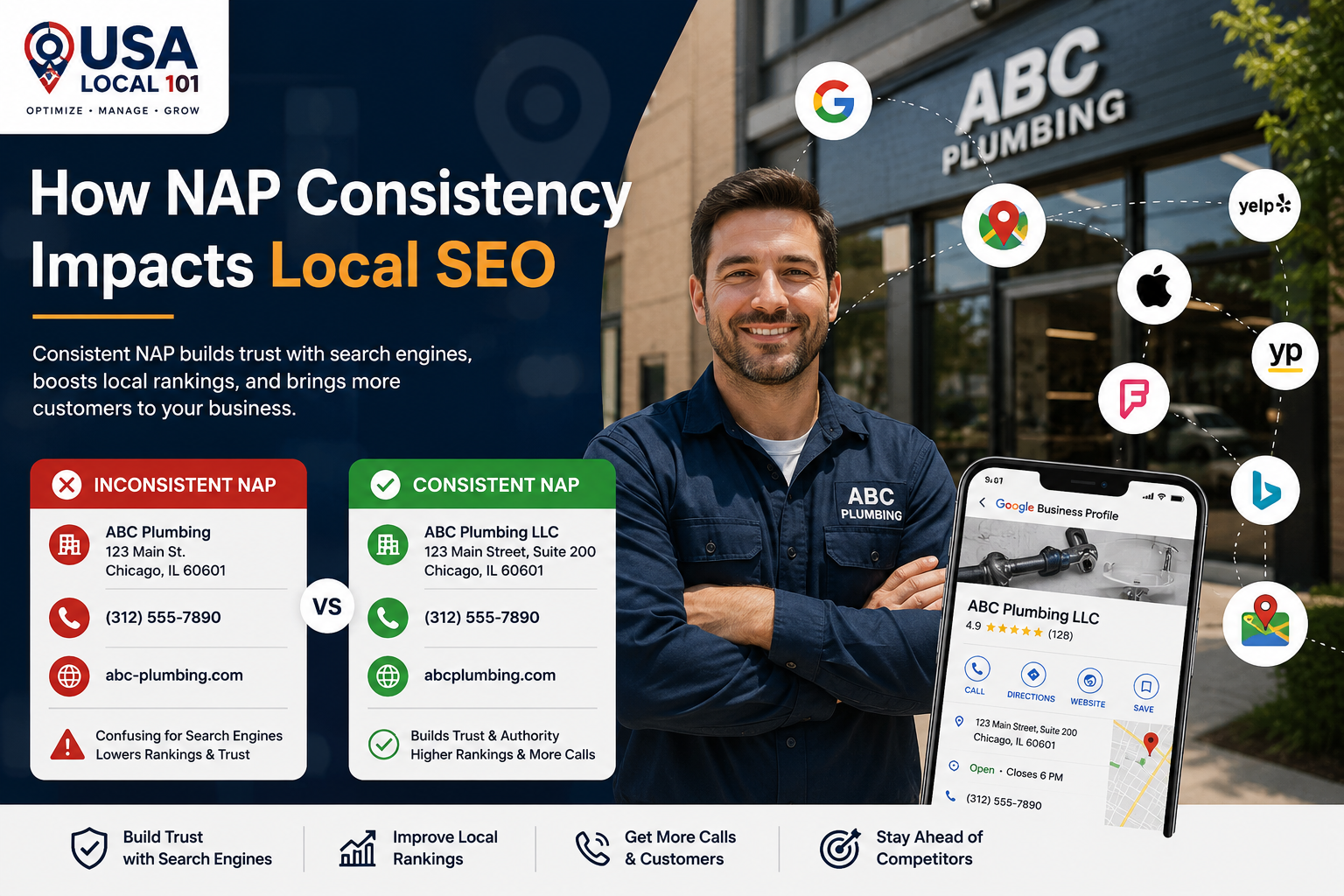
How NAP Consistency Impacts Local SEO
Over the past six months, a Chicago business lost 34% of its phone calls without making any changes to its offerings, prices or reviews. The culprit? A data aggregator had propagated an old suite number from a 2019 office move across 47 directories and Google quietly stopped trusting the listing. That’s not a fringe case. That’s how Local Businesses die from NAP inconsistency not because a penalty hit their rankings, not because an update hit their rankings, but because the death of trust hit them – the death of the single most important consideration in Google’s local ranking algorithm: cross-referenced data. When Google decides whether you’re Local 3-Pack-worthy, it matches your business entity to citation ecosystems, data aggregators, LocalBusiness schema and every inconsistency introduces uncertainty. Google ranks the business it trusts more.
What NAP Consistency Actually Means (And What Most Businesses Get Wrong)
When most business owners hear “keep your information consistent” they think “and my website”. This is the least of the issues.
Your business name, address and phone number (NAP) information is published across hundreds of local citations business directories, data aggregators, review sites, social media profiles, industry specific listings and maps. Anywhere your business name, address or phone number is published is a citation. And every inconsistency across those citations sends a conflicting signal to search engine crawlers.
It’s the small inconsistencies that do the most damage:
“St.” vs “Street” in your address
- Building suite numbers on some sites but not on others
- Call tracking used in advertising, spilling over into listing information
- Previous business names from a rebrand still on Yelp, Yellow Pages, or Foursquare
- Multiple Google Business Profiles with different phone numbers
Google uses entity search to ensure that the business it sees on your website is the same business it sees on Bing Places, Apple Maps and TripAdvisor – the 50 other sites where you might have a listing. If the information isn’t consistent, Google doesn’t completely trust any of it and your local rankings suffer.
The major data aggregators Data Axle, Neustar Localeze, Foursquare (the B2B data arm) and Acxiom automatically provide your business information to the secondary directories. If your NAP is wrong at the aggregator level, it spreads like a fracture through the entire citation ecosystem. Fixing one listing on Google without addressing the source means corrupted data will resurface within weeks.
How Google Uses NAP Data to Calculate Local Authority
The three main factors in Google’s local algorithm are relevance, proximity and prominence. Prominence is the element of the ranking algorithm that you can control without relocating and NAP consistency is the key factor that affects prominence.
Google will use its Knowledge Graph to check your business when it crawls your listing. If your business is listed consistently in high-authority publications with identical NAP information, Google sees this as a strong signal of trust. It helps it verify your business is real, legitimate and well represented. That boosts your local organic rankings and lifts your chances of landing in the 3-Pack.
Where Most Businesses Miss the Nuance
- Citation volume matters less than citation accuracy. 300 inconsistent citations hurt worse than 80 clean, consistent ones.
- Domain authority of citation sources amplifies impact a NAP match on Google Business Profile, Apple Maps, and the Better Business Bureau carries more weight than matches on low-authority directories.
- Structured vs. unstructured citations work differently. A structured citation is a formal directory listing. An unstructured citation is a mention in a blog post, a news article, or a local publication and these also need to reflect accurate NAP data.
- Schema markup on your website acts as a NAP anchor. Using LocalBusiness schema with your exact name, address, and phone number tells Google’s crawlers which version of your NAP is authoritative. If your schema doesn’t match your Google Business Profile, you’re introducing a conflict at the most fundamental level.
Citation consistency is a top-five Map Pack ranking factor in the annual local search ranking factors surveys by Whitespark and BrightLocal. When businesses fix citation inconsistencies, they typically see their rankings improve in 60-90 days (depending on how frequently Google re-crawls the sites).
The Real-World Damage Inconsistent NAP Does to Your Rankings
Let’s move past theory. Here’s what actually happens to a local business when NAP data fragments over time and it fragments faster than most owners realize.
Rankings slip without a clear cause. A business that was ranking third in the local pack for “emergency plumber Dallas” starts dropping to sixth, then off the pack entirely. No penalty, no algorithm update targeted them specifically just accumulated citation noise that eroded their local authority score over months.
Duplicate listings split ranking authority. A restaurant relocates and adds a new Google Business Profile, but doesn’t delete the old one. Google now has two listings for the same business entity two locations, sometimes two phone numbers, maybe two different names if the restaurateur used a DBA in one listing. Neither will rank like a proper single listing would.
Voice search breaks completely. If someone asks Siri or the Google Assistant about your hours of operation or phone number, the assistants will draw from structured data sources. If your name, address and phone number (NAP) details are inconsistent, the information may be incorrect or no information will be displayed.
Click-to-call campaigns waste budget. Local PPC campaigns sometimes reveal that call tracking numbers have been “scraped” and distributed into directories as the new business number. Now paid and organic traffic are landing on numbers that will “go away”.
Multi-location businesses face amplified risk. Every location has its own citation profile. A business with 12 locations has 12 different NAP identities to manage, and 12 opportunities for NAP inconsistencies to develop. Without a process for managing citations, site-specific rankings degrade invisibly.
Local search results in highly competitive markets do not necessarily go to the companies with the most reviews, or the websites with the highest domain authority. They’re the companies that have managed to put a clear, consistent, verifiable citation profile in place.
How to Actually Fix and Maintain NAP Consistency
It’s a process, not a one-and-done job. It requires an audit, a correction phase, and ongoing maintenance.
Start with a citation audit: Run your business through tools like Whitespark Citation Finder, BrightLocal or Moz Local to get a list of all your online citations. You want to see how your name and address are written, phone number, URL. Make note of all the variations, but don’t make any changes yet.
Establish your canonical NAP: Determine how you will enter your business name, address and phone number will it be abbreviated, suite numbers, country codes in the phone number? Google Business is your most important listing and should be considered your primary source.
Implement LocalBusiness schema on your website. Your website’s structured data markup should match your canonical NAP exactly. Use Google’s Rich Results Test to confirm it’s reading correctly.
Monitor for drift: Citation data is not a once-and-done effort. Data aggregators refresh their data, users update Google Maps with wrong data, and new websites scrape old out-of-date data. Regular monthly checks prevent issues.
Conclusion
NAP consistency is not a once-off task to be checked off a list it’s a critical piece of local search infrastructure to be maintained. Businesses that treat it as background maintenance consistently outperform competitors who don’t in local pack visibility, organic local rankings, and customer trust metrics that compound over time. If you’re not sure how your citations are currently performing or if you have unexplained local ranking fluctuations, USA Local 101 is good at this type of local search infrastructure work, citation audits, canonical NAP roll-outs and the type of cleanup that leads to long-term local presence.
Recent Posts
Top 5 Reliable Gas Line Installation Services in Roanoke, TX
5 Best Slab Leak Detection & Repair Services in Keller, TX