
How to Find Trusted Local Businesses Online?
More than 85% of consumers have been ripped off by a service provider they found online either charged too much, stood them up, or delivered substandard work – all while appearing to be a good fit in search results. You type “best plumber near me,” pick the top result, and trust the stars. The technician shows up late, quotes triple the original price at your doorstep, and disappears before the job is done. Your online review doesn’t make up for the waste of time and money. The internet didn’t make it easier to find local business. It made it easier to look reliable without being reliable. The trick to not getting ripped off is knowing where to look, where to avoid and where to ignore.
Start With Google Business Profile But Read It Critically
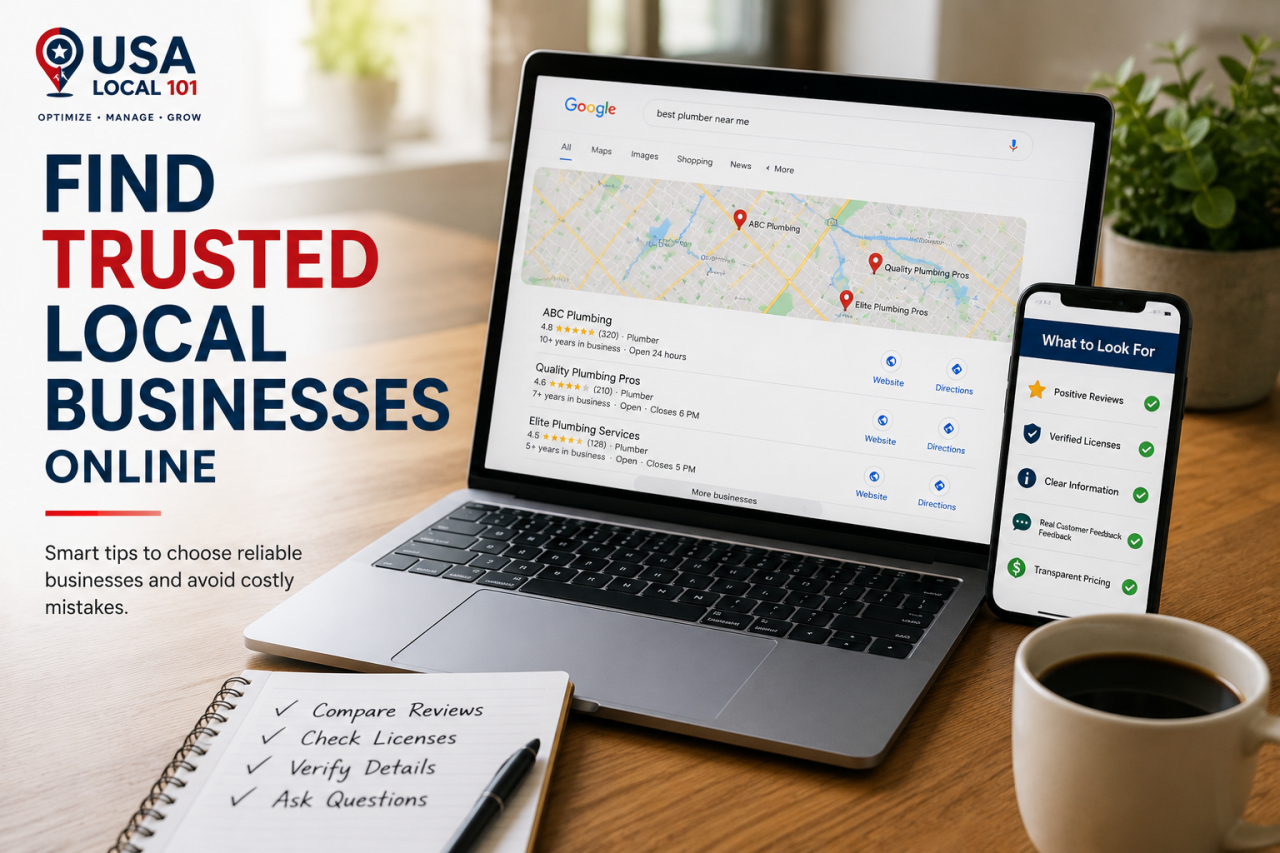
When you look for a local business service, the first results you get are Google’s Business Profiles. They display the company name, address, telephone number, operating hours, images and critically important reviews.
But don’t stop at the star rating. A 4.2 with 11 reviews is not very informative. A 4.2-star rating with 847 reviews over two years of time is very helpful. Consider number of reviews, consistency of reviews, and the date the reviews were written. A business with great reviews in 2021, but no reviews since, may have taken a turn for the worse.
And look for owner interactions. If a business responds to positive and negative reviews, it’s accountable a key indicator of business trustworthiness.
Cross-Check Across Multiple Review Platforms
The biggest mistake that people make is relying on one site. Savvy shoppers check listings on several local business directories before contacting.
Look up the business on:
- Yelp particularly strong for restaurants, salons, and home services
- Better Business Bureau (BBB) displays complaint record, accreditation and resolution
- Angi (formerly known as Angie’s List) primarily for contractors with verified reviews
- Trustpilot service companies and e-commerce businesses with local presence
- Nextdoor your real neighbors with reviews for local businesses in your neighborhood
200 reviews on Google, 0 on BBB, 1 on Yelp (and suspect) is a red flag. Consistent NAP data Name, Address, and Phone number appearing the same across platforms is a basic trust indicator. Mismatched information suggests either poor management or, worse, deliberate manipulation.
Verify Licensing, Insurance, and Certifications
This step alone separates cautious consumers from vulnerable ones. All local contractors, electricians, plumbers, roofers, and health care professionals should have state licenses and liability insurance.
Don’t just ask verify. Very state in the U.S. offers a contractor license search on its state website. Enter “[your state] contractor license lookup” and you’ll be given a database. Look up the name or license number they gave you to make sure it’s good standing.
For service providers such as accountants, real estate brokers and therapists, verify their licenses with the appropriate licensing board. An accountant should be licensed by your state’s Board of Accountancy. A therapist should be listed in your state’s mental health licensing board.
If a business is slow to provide you with their license number or gives you an ambiguous response
Use Local Chamber of Commerce and City Directories
Chamber of Commerce membership is a little-known trust signal. Your local Chamber of Commerce screen members to a lesser degree, and businesses that pay for membership are more likely to be established and involved in the community.
Go to your city or county Chamber of Commerce website, and look at the members list. They’ll often include years of membership, category of business and contact details. This is a great resource for business-to-business services, professional services and retail in smaller metropolitan areas.
Likewise, many cities have their own local business registries or economic development directories that identify registered businesses in the city.
Look for Real Social Proof Beyond Star Ratings
Customer testimonials on a business’s own website are basically useless as trust signals every business curates those. What you want is unfiltered, third-party social proof.
Look at their Facebook Business Page. Read their posts and comments, and the “Reviews” section if they have it turned on. Look at comments beneath their posts customers often leave feedback there that’s not published on Google or Yelp.
Look them up on Reddit and local Facebook groups. Search Reddit with keywords “[Business Name] + [City]”. These are very honest communities where unhappy customers often post long, detailed warnings that may be edited out of review sites.
Watch videos the business has posted on YouTube. Video of real work, people and processes is much more difficult to manipulate than a website.
Evaluate the Business Website for Credibility Signals
A professional, well-maintained website doesn’t guarantee quality but a sloppy, outdated, or suspicious website is a meaningful warning sign.
When assessing a local business website, look for:
- Physical address listed on the contact page (not just a P.O. box)
- Real staff photos with names and titles not generic stock images
- Portfolio or case studies showing actual past work
- HTTPS security (padlock in the browser bar)
- A Privacy Policy and Terms of Service page
- Awards, certifications, or industry affiliations with verifiable links
Businesses that have invested in local SEO and maintain an updated blog or news section are typically more established and invested in their long-term reputation. Look for schema markup indicators like star ratings appearing directly in search results this shows technical competence and legitimacy.
Ask the Right Questions Before You Hire
Once you’ve shortlisted a business, don’t skip the direct conversation. Call them. Notice how they answer. A legitimate business picks up the phone during business hours, gives you a clear company name when answering, and doesn’t pressure you into making fast decisions.
Ask for:
- References from recent local clients (not just names actual contact info)
- Written estimates with line-item breakdowns before any work begins
- Proof of insurance request the certificate, not just a verbal confirmation
- Contract terms clearly stating scope, timeline, and payment schedule
Any business that resists providing these basics is not worth your time or money, regardless of how polished their Google listing looks.
Watch for These Red Flags
No matter how good a business looks on paper, these patterns should stop you cold:
- Only five-star reviews with no negatives statistically improbable and often signals fake reviews
- Reviews with generic language (“Great service! Highly recommend!”) and no specifics
- Business registered less than six months ago with an unusually high review count
- No physical address or a residential address for a business claiming large-scale operations
- Pressure tactics urgency language, “limited time” quotes, or insistence on cash-only payments
Conclusion
It’s not hard to find a reputable local business online, but it does take some effort. Cross-check reviews, licenses, social media and conversations. Don’t rely on one site or a star rating.
You have all the tools and clues. Most people simply don’t use them.
If you want a hand, USA Local 101 is a hand-curated local business listing site designed to help consumers connect with reputable local businesses in order to spend less time researching and more time doing what you need to get done.
Recent Posts
Top 5 Reliable Gas Line Installation Services in Roanoke, TX
5 Best Slab Leak Detection & Repair Services in Keller, TX