
How to Optimize Your Business Listing for Maximum Exposure
73% of customers will never go back to a business if they find inaccurate information in its listing not because they have bad service, but because the listing is bad first. That’s the silent killer of local business growth. Your next customer isn’t driving around looking for your sign. They’re searching Google at 9 PM, comparing three businesses in under 60 seconds. Your Google Business Profile, your Yelp listing, your Apple Maps listing that’s your first impression now. If you don’t have the right information, no photos and no reviews, you just lost that customer to the business that spent 30 minutes on their listing. Here’s how to make sure it doesn’t happen again.
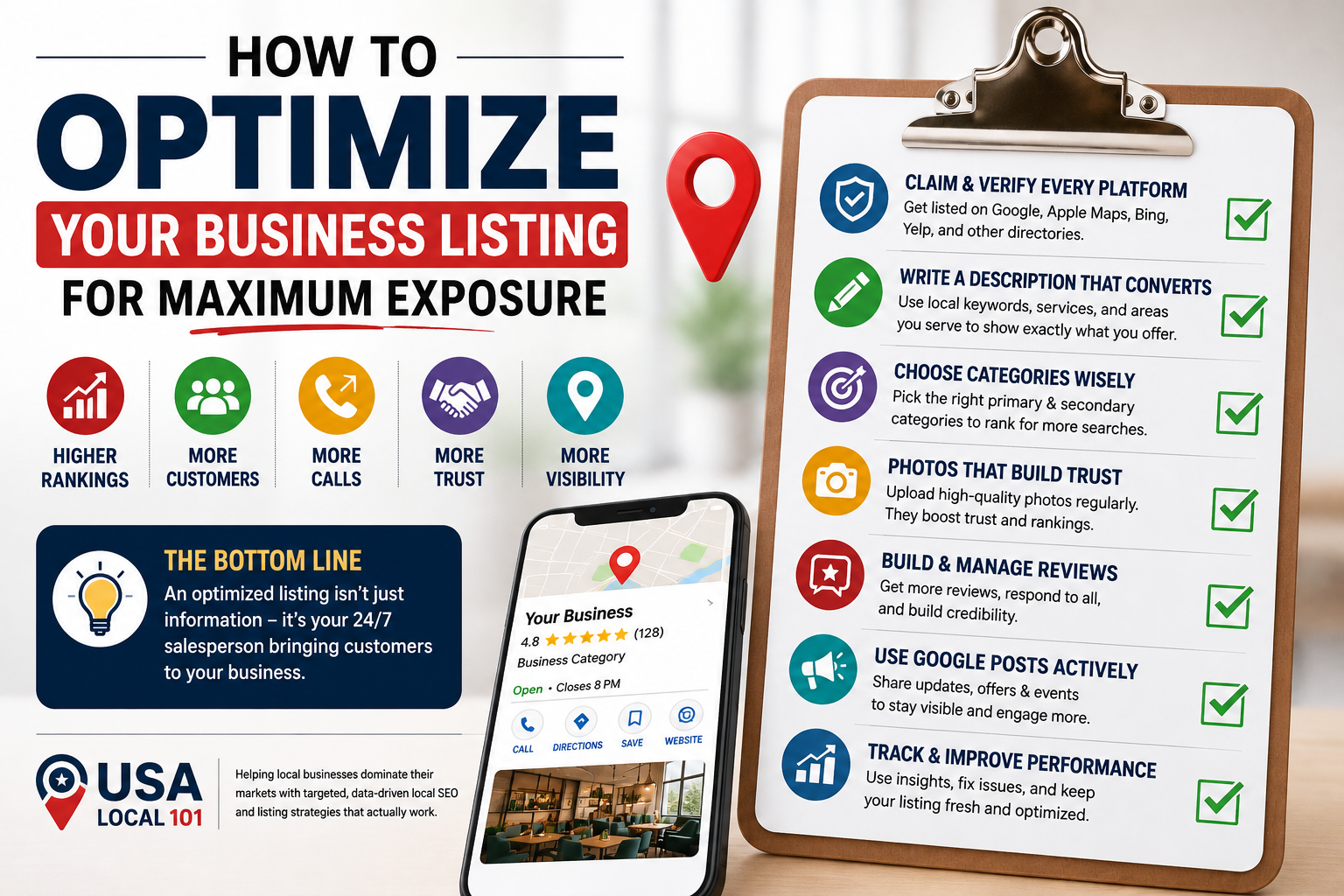
Claim and Verify Every Platform, Not Just Google
Most businesses only worry about Google Business Profile (GBP). That’s a mistake. Apple Maps, Bing Places, Yelp, Facebook Business Pages, Foursquare, Yelp, and local business directory (Houzz for contractors, Zocdoc for health care, TripAdvisor for hospitality) are only a few of the directories in your listing ecosystem.
Each unverified listing is a data liability. Third-party aggregators like Data Axle and Neustar Localeze pull business information from these sources and distribute it across hundreds of directories. If your NAP data (Name, Address, Phone number) is inconsistent across even two major platforms, you trigger citation conflicts that confuse search engine crawlers and drop your local pack rankings.
Claim every listing. Verify ownership. Be consistent with your NAP data if your address is “Suite 200” on one site, it should be “Ste. 200” on others.
Write a Business Description That Targets Intent, Not Just Identity
Your business description isn’t a mission statement. It’s a geo-targeted conversion tool. Typically entrepreneurs will write: “We are a family-owned, quality plumbing company.” That doesn’t tell Google anything.
But cram your description full of local keywords, service-specific keywords, and problem keywords. A better version: “We provide emergency plumbing repair, water heater installation, and drain cleaning across Dallas, TX, including Richardson, Plano, and Garland.”
This method establishes topical authority for local search rankings by flagging your service area, service categories and geographic coverage, all in one go. Use all the space (750 characters on GBP). Don’t waste it.
Choose Categories With Surgical Precision
The biggest thing you can do to improve your Google Business Profile ranking is to choose the right primary category. If you select the category “Contractor” instead of “Roofing Contractor”, your business will not come up in the right searches.
Here’s how a dentist should set up their categories:
- Primary category: Dentist the most common and general search for your service
- Secondary category: Cosmetic Dentist targets those looking for whitening, veneers and smile makeovers
- Secondary category: Emergency Dental Service captures urgent, high-converting searches
- Secondary category: Teeth Whitening Service provides a new set of keywords with high commercial intent
- Secondary category: Kid’s Dentist when applicable this can double local search visibility
Look at your competitors using tools such as Pleper to find out what categories they’re appearing in. Then target the same number or more. Every extra category is a new avenue to get found for local search terms you’re not yet ranking for.
Photos Aren’t Optional They’re Ranking Signals
Stores that have uploaded over 100 photos to Google Business Profile get 520% more calls than those with less than ten. Google’s algorithm assumes engagement with photos is a good sign, and engagement is a factor for local 3-pack rankings.
Post photos from all aspects of the customers’ experience:
- Outside photos: from the street to help customers find you; show your signs
- Interior photos: waiting room, office or the store so first-time customers know what to expect
- Team photos: human faces build trust faster than any written claim; name your staff in the captions
- Before-and-after photos: essential for service providers such as landscapers, car detailers or home improvements
- Product photos: photos with natural light and simple backgrounds, not clipart
Use of descriptive file names for all photos “dallas-roof-repair-before.jpg” is more valuable for on-page SEO than “IMG_4892.jpg”. Post new photos weekly. New photos show Google you are alive and kicking – another important local ranking factor.
Build a Review Strategy, Not Just a Review Request
Your reviews are the most front-of-mind trust factor on your listing pages, and they do double duty: they are important for the customer’s decision making and they impact your local search rankings. But we don’t want just a large number of reviews, we want recent reviews, contain relevant keywords, and are responded to.
Request reviews as soon after a good experience as possible. Click to review: link to your Google review page. SMS review requests are much more effective than email.
The more keywords your reviews contain, the better their relevance scoring. You can even nudge them by saying: “Please feel free to mention the service we provided.”
Respond to all reviews positive and negative. A response to a negative review is often more convincing to potential customers. A polite, businesslike response that suggests a way forward (or offers compensation) is a public display of business integrity.
Use Google Posts to Feed the Algorithm Actively
Google Posts are like a social media feed on your Google listing. Posts are only live for a week, so Google is rewarding frequent posting. Few businesses take advantage of this so this is one of the easiest ways to get ahead of the local competition, quickly.
Use posts strategically:
Time-sensitive promotions: “10% off HVAC tune-ups if you book before Friday” provides urgency and direct phone calls
Seasonal services, a lawn company advertising “spring lawn aeration in Phoenix” is seasonal and geo-specific
Product and service announcements: announce new menu items, services or new staff
Events and community events: Google values E-E-A-T signals; being in the community is good for trust and authority
Q&A seeding: publish customer questions with answers to get ahead of the curve
Each post should have a CTA (Book Now, Call Today, Learn More) and an image. Link post content to search intent to encourage click-through.
Track Performance With Listing Insights and Fix What’s Leaking
Google Business Profile (GBP) Insights reveals how your customers are searching for your listing: direct, discovery and branded searches. If discovery searches are low, you need to optimize your category and description. If your direct searches are high but your actions (calls, direction, website) are low, your images or reviews need to be improved.
Set a monthly audit schedule. Eliminate duplicates that Google automatically generates when data aggregators send inconsistent info. Duplicate listings split your review equity and dilute your ranking authority, merge or report them immediately.
Monitor citation consistency quarterly using tools like BrightLocal or Whitespark. A single outdated address on a high-authority directory can suppress your rankings for months.
Why Most Business Listings Never Reach Their Full Potential
Most companies will claim their Google Business Profile, add the essentials and leave it at that. And that’s where the difference is between listings that get regular inbound leads and listings that languish on page two of Google.
It’s not always the reviews or the backlink profile, it’s the sheer volume of under-optimised business attributes, unverified service area information, blank product and service listings, and outdated photos collected since the initial listing was set up. Google’s local search algorithm favours dynamic, complete listings. An account that receives regular Google Business Profile posts, regularly updated business hours, and owner responses to reviews, communicates to Google that this is an active, real business and that behaviour serves to boost local pack rankings.
The Bottom Line
Optimizing a business listing isn’t a one-time task; it’s an ongoing process of feeding Google fresh signals, maintaining data consistency, and building the kind of social proof and engagement metrics that move you up in local rankings. Companies that appear in the “local 3-pack” aren’t there by chance. They’re there because they’re taking care of every aspect of their listing. If you’re looking for a partner to develop and manage a listing and local SEO strategy to drive foot traffic and phone calls, USA Local 101 does this all the time helping local businesses dominate their markets with targeted, data-based local SEO and listing strategies that competitors can’t duplicate.
Recent Posts
Top 5 Reliable Gas Line Installation Services in Roanoke, TX
5 Best Slab Leak Detection & Repair Services in Keller, TX