

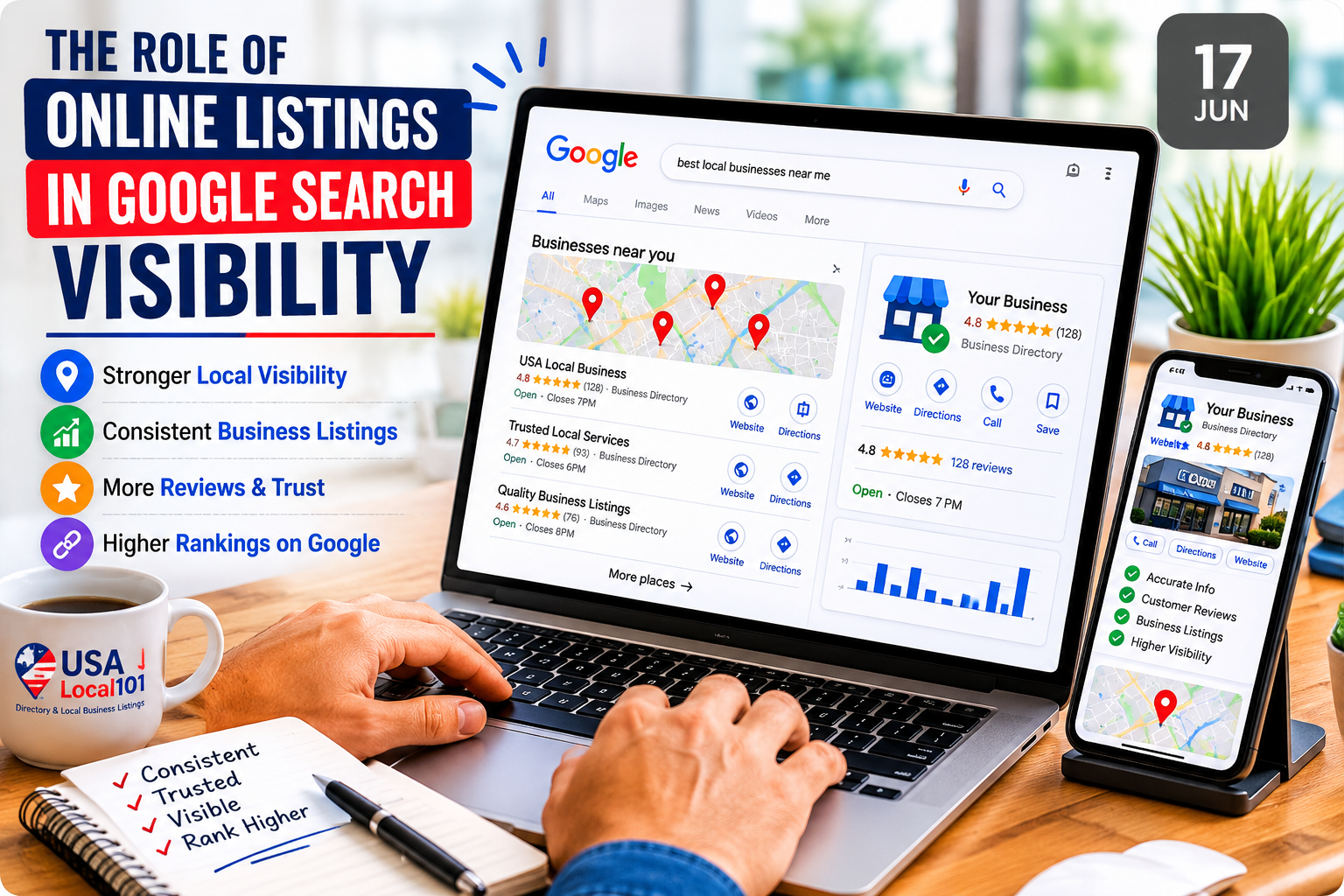
The Role of Online Listings in Google Search Visibility
An estimated 68% of all internet experiences start with a search engine and for local businesses, the first search result leads to a new customer, or a lost opportunity. We all focus on website, social media and advertising. Few focus on online listings the most underdeveloped attribute in Google search rankings for local businesses. If Google is not certain your business is real there’s no way it will rank you. It’s that simple.
Why Google Needs More Than Your Website
Your website tells Google what you want people to know. Consultations tell Google what’s independently verifiable. This makes a huge difference to the algorithm’s authority ranking.
Google’s local search algorithm is based on three things: relevance, distance and prominence. Your website influences relevance. Distance is affected by your location. But prominence the difference between a business listed in the top three and one on page two of the search results comes from off-site factors. The main source of these signals is listings.
When Google sees your business name, address and phone number listed on reputable local business listings sites such as Yelp, Bing Places, Apple Maps, and niche-specific sites, it creates an entity profile in its Knowledge Graph. This entity profile drives your Google Business Profile listing, your local 3-pack listing, and your voice search listing. Without it, Google considers your business unverified and unverified businesses don’t rank confidently.
The Knowledge Graph Connection Most Businesses Miss
The Knowledge Graph of Google is a database of entities in the real world and how they relate to each other. Once your business attains Knowledge Graph status, Google is already aware that it is a trusted entity and not merely a set of web pages and this recognition directly improves search visibility.
This is hastened by online listings, which offer machine-readable, structured information on a number of independent websites. Particular cues that nourish Knowledge Graph recognition consist of:
- The same format of your business name in all platforms, verifying your identity as an entity.
- Validated physical address information matched your Google Business Profile.
- Business category tags define your industry vertical and relevance of services.
- Citations to your presence in the directory via the URLs of your websites back to your domain, which reinforces domain authority signals.
As soon as the Knowledge Graph of Google considers your business as a trusted entity, you stand a much better chance of gaining access to a Knowledge Panel the information box on the right side of search results. Your reviews, hours, photos and contact information are shown at that panel on top of organic results and can trigger direct calls before the user even opens your website.
How Listing Quality Directly Affects Search Rankings
Listings are not created equal. A fully completed listing on a high domain authority directory sends a stronger signal than a bare-bones entry on an obscure platform. Google uses a number of factors to assess the quality of listing:
- Complete profile: Inclusion of profiles with description, service types, photographs, and hours of operation give Google more semantic information to index.
- Review presence and recency: active customer reviews add reputation signals and user-generated keyword content Google indexes as relevance data
- Stating stability: a listing that is not changed in two years has greater authority than one that was created last month, an indication of business legitimacy.
- Inbound link value directory: listing back to your website are local backlinks, which is part of the overall link authority profile of your domain.
Companies that consider listings as living, actively managed assets that refresh photos, reply to reviews, keep hours up-to-date experience compounding SEO advantages, which only get stronger month by month.
The Direct Impact on Google’s Local 3-Pack
The local 3-pack receives about 44% of any clicks to location-based searches. The distinction between regular inbound leads and complete reliance on referrals or paid advertisements is ranking within it versus underneath it.
Online directories affect local 3-pack positions in three ways:
- The volume and consistency of citations forms the prominence score that Google relies on to rank businesses the more the citations are made by authoritative sites, the higher the prominence score.
- Aggregation of reviews on various listing sites contributes to Google reputation signals, and a company with a high profile of reviews on multiple listing sites will always outperform the one that has a single listing platform review profile.
- Relevance matching on certain service queries through category and keyword alignment of your listing profiles and Google Business Profile enhances relevance.
A pest control company maintaining complete listings on Google, Yelp, Bing Places, Angi, and regional chamber directories with consistent NAP data and active review management will reliably outrank a competitor with a better website but weaker listing infrastructure. The algorithm checks in the trust, and trust is established by checking over independent sources.
Voice Search and AI Overviews Pull Directly From Listings
Voice search drives a significant share of local queries “find a dentist near me,” “plumber in Chicago available today,” “best Italian restaurant open now.” The responses provided by Siri, Alexa and Google Assistant are based on structured data sources and local business directory USA are one of the major structured data sources that these systems rely on.
Now Google Search displays AI Overviews above ordinary search results on local queries that have thousands of results. These AI-made summaries use authenticated business entities in responding to questions of best [service] in [city] inquiries. Companies that have excellent Knowledge Graph recognition created by regular online listing are listed in these summaries. Those businesses that lack that base are totally unseen in them, no matter how well their web site is.
Unless your listing is complete and consistent across the major platforms, you are practically non-existent in voice search, and AI-driven results not in the future, but in the present.
The Compounding Advantage of Getting This Right Early
Every month a business delays building a strong listing presence is a month competitors are compounding their citation authority ahead of them. A competitor that has been able to keep all 30 listing platforms over 3 years has established an SEO base that no novice can even mimic within a short period of time notwithstanding the budgetary allocations.
The companies that have dominated search results on Google in the area have constructed it by optimizing their websites, managing Google Business Profiles, and maintaining a continuous presence on the listing that Google interprets as the same story at every place that Google visits.
Start building that foundation on USA Local 101 a trusted directory platform designed to strengthen your local citation profile and put your business where the right customers are already searching.
Recent Posts
Top 5 Reliable Gas Line Installation Services in Roanoke, TX
5 Best Slab Leak Detection & Repair Services in Keller, TX