
Top Local SEO Tips for Small Businesses
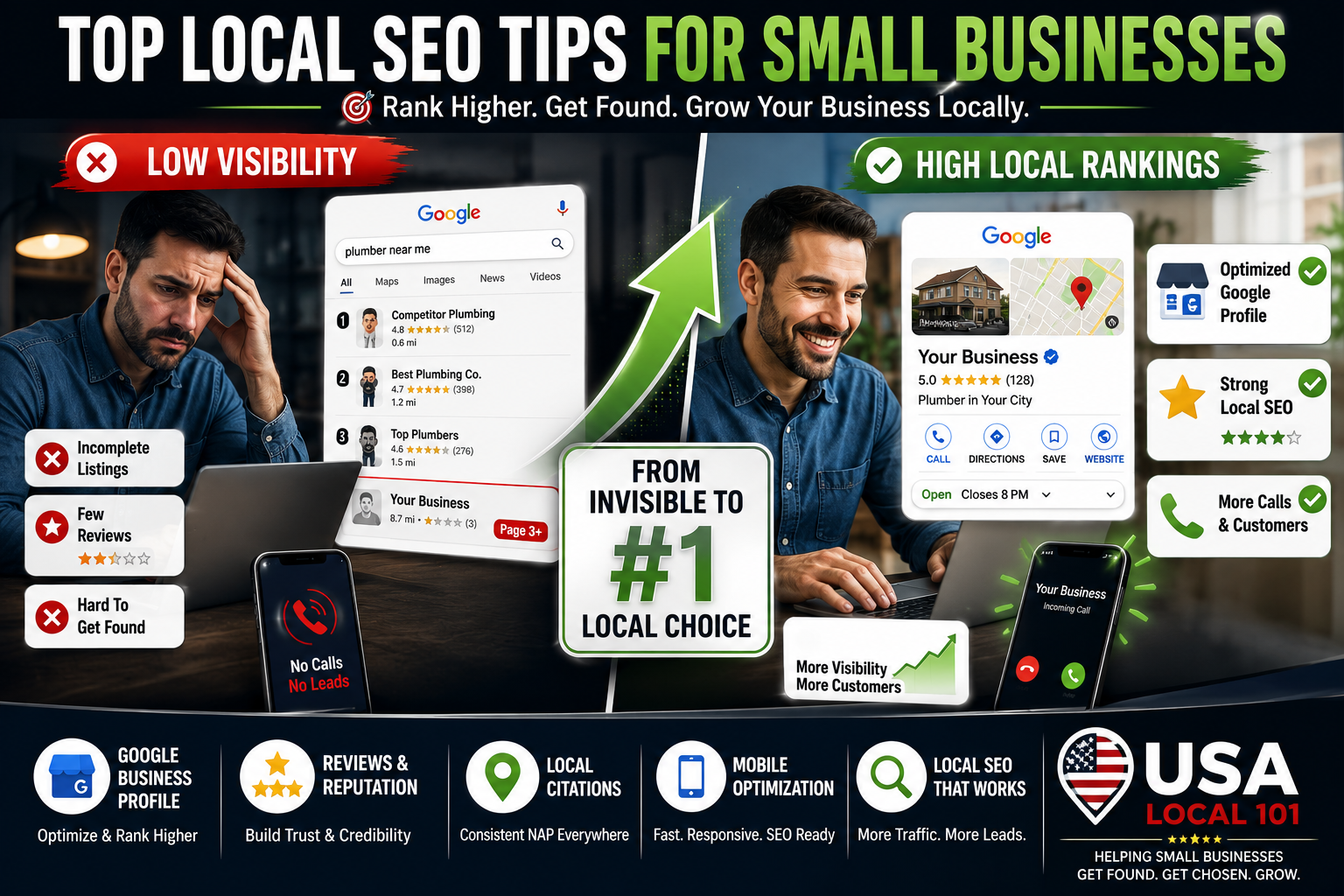
93% of consumers used the internet to find a local business last year. But this statistic doesn’t tell you this: Most of those searches never make it past the first three results. If your business isn’t part of that top group, you’re essentially not there until your customers find you, and they’re already out to buy what you’re selling, with their credit cards in hand.
Small business owners invest in Instagram advertising, flyers, and word of mouth, all good but neglect local search, where purchase intent is most pronounced. Someone scrolling Instagram might be killing time. If anyone types in emergency plumber near me at 11 pm, then he or she needs a plumber to help them out – and he or she will call the first result that he or she thinks is trustworthy.
There is no budget difference between businesses that control the local search and those that don’t. It’s all about knowing which signals Google is paying attention to in 2026.
These are the real drivers of the day.
1. Stop Treating Your Google Business Profile Like a Yellow Pages Listing
Your Google Business Profile (GBP) is your strongest local SEO tool available and most small businesses think of it as “a set it and forget it” phonebook listing. What a huge error!
The first step is optimizing your Google Business Profile, which accounts for 32% of local ranking factors, and then having consistent citations to your business across directories is a way to validate your business presence. Every field matters. What you actually need to do:
Choose your primary category with surgical precision: Your GBP category is the number one ranking factor for your Google Search and Maps listing. Choose one of the most relevant attributes which exactly describes your core business and 2-3 secondary attributes which give a more detailed picture. Do not use overly general categories – don’t select “restaurant” if you previously selected “Chinese restaurant.
Upload photos regularly, not just once: Businesses that regularly upload new photos send a message to Google’s algorithm of activity and trustworthiness. You need to post at least 4-5 new pictures per month, these would include your storefront, team, products and pictures behind the scenes.
Use the Posts feature like a mini social feed: Most businesses never use GBP Posts. This is real estate that is free. Share weekly updates on promotions, new products, events, or even employees highlights. Every post maintains your profile active, and it’s an indicator for Google that you’re active.
Keep your hours obsessively accurate: Accuracy in business hours is crucial for local SEO and customer trust. Keep them current with holiday, special closing and seasonal information. One of the quickest ways to damage your reputation and ranking is an incorrect “Open” status when you are really closed.
2. Build Your NAP Consistency Like Your Business Depends on It (Because It Does)
NAP (Name, Address, Phone Number) is a must-have and must be consistent on every single online directory. Directories need to be consistent in terms of your business name, address and phone number. However, if your address is “St.” on Google and “Street” on Yelp, then that alone is sapping your local authority without you realizing it.
Do a complete citation check with a tool like BrightLocal or Moz Local. Look up all these listings: Yelp, Bing Places, Apple Maps, Foursquare, Facebook and industry-specific directories. Correct the differences individually. This can be a bit of a grudge, but after you’ve got your NAP consistent across the board, your local trust indicators begin to amass quickly.
3. Turn Your Review Strategy Into a System, Not an Afterthought
Genuine, positive reviews are one of the highest weighted local SEO ranking factors in 2026. But most small businesses take a passive approach they hope customers leave reviews on their own. That’s leaving ranking power on the table.
Here’s a system that works:
Ask at the peak of satisfaction: The best moment to ask for a review is immediately after a positive customer experience not a week later in an email they’ll ignore. Train your staff to ask in person: “If you enjoyed your experience today, we’d really appreciate a Google review it takes 30 seconds and means the world to us.”
Send a direct review link via SMS: Most people will not hunt for your Google listing to leave a review. Send them a direct link in a follow-up text. Conversion rates are dramatically higher when the friction is removed.
Respond to all reviews both positive and negative professionally. This improves engagement signals for your GBP and can turn a negative review into a positive one.
Diversify beyond Google: Although Google reviews are most important, aim to collect reviews across other relevant platforms such as Yelp, Tripadvisor, and industry-specific directories. A plumber should also be on Angi. A restaurant should be active on Yelp and TripAdvisor. The broader your review footprint, the stronger your overall local authority.
This is where most small companies totally fail. They have no blog, or they have blogs which are like “Tips for Homeowners” and anybody can write it, anywhere. Google pays attention to the specific, and the local.
Content which addresses local queries, or local interests can help match your site to local searcher intent. Consider typing in “best dentist in (city)”, “events in (neighborhood)” or “home cleaning service near me”. Local blogging, event pages, and community guides are all part of smart local search optimization that works in 2026.
Concrete content ideas:
- “Best time to schedule HVAC maintenance in (your city) a local guide”
- The tips that every City homeowner should know prior to a kitchen remodeling.
- A one-page web page for each neighborhood or suburb that you serve, with a true local flavor (talk about local places, special events, known streets, etc.)
Build landing pages for each city, neighborhood, or service area you have in your area and use hyperlocal key words. You have 3 cities, so you need 3 different and distinct pages, not one where you simply put different city names.
5. Optimize for Mobile and Page Speed Like Your Rankings Depend on It
Mobile search dominates local discovery. In 2026, a fast, responsive, and user-friendly mobile site is one of the key local SEO signals for higher rankings. Mobile-first indexing means your site’s mobile experience is the one Google evaluates first.
Run your site through Google PageSpeed Insights right now. A score below 70 is a problem. The most common fixes for small business sites:
- Compress images before uploading (use a tool like TinyPNG)
- Remove unused plugins if you’re on WordPress
- Enable browser caching through your hosting provider
- Upgrade to faster hosting if you’re on shared budget hosting
57% of local searches come from mobile devices, so a site that’s clunky on a phone is costing you real customers every single day.
6. Earn Local Backlinks Not Random Ones
Links from reputable websites and local news publications improve credibility in Google’s eyes. But not all links are equal a link from your city’s Chamber of Commerce is worth far more than a random directory submission.
Specific ways to earn high-quality local backlinks:
- Sponsor a local event organizers almost always link back to sponsors
- Get featured in local news pitch a genuinely interesting story about your business to your local paper or news blog
- Partner with complementary local businesses a wedding photographer linking to a florist, or a gym linking to a nutritionist
- Join your local Chamber of Commerce most Chambers have a member directory that links to your site
7. Optimize for Voice Search and AI Overviews
Users prefer voice search three times more, compared to typing a local query, into text search. Voice queries are conversational, and question-based. Someone doesn’t say “plumber Houston” into Siri they say “Who’s the best plumber near me that’s open right now?”
Questions should be answered in natural language on a FAQ page of your website and on your service pages. People are searching for answers to questions like “Are you open on Sundays?”, “Do you offer free estimates?” and “What areas do you serve?” and these queries are exactly what it reflects. AI Overviews can drive views and clicks without a scroll, so optimize accordingly, using the information provided in a clear and concise manner that search results are likely to capture.
The Bottom Line
Local SEO is not a one-time project it’s an ongoing discipline. The companies that will rule their markets in 2026 are the ones that are making it a part of their business, not something they do once in a while. Optimize your Google Business Profile, update your citations, develop a review program, and produce authentic local content. If you do those four things, then you will outrank 80% of your local competition.
For those that desire guidance from the professionals to accelerate these results, USA Local 101 is here to help small businesses achieve domination in their local markets using proven local SEO strategies that don’t have a lot of fluff. Whether it’s GBP optimization, citation management, hyperlocal content, or review systems, their team understands what is required to help your business get in front of customers who are already looking for you.
Recent Posts
Top 5 Reliable Gas Line Installation Services in Roanoke, TX
5 Best Slab Leak Detection & Repair Services in Keller, TX