
How to Rank Your Business in Local Search
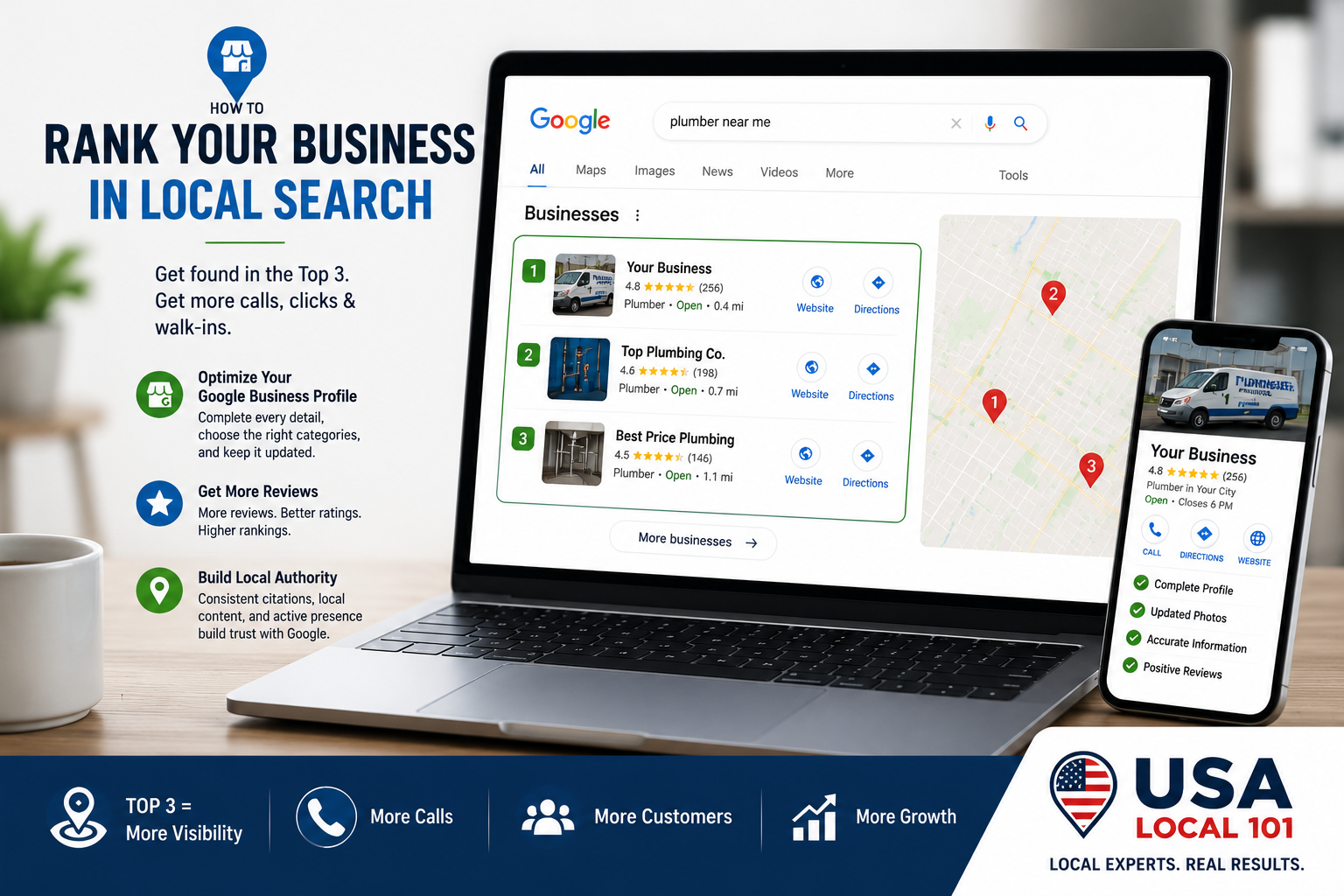
Google results page has three positions at the top of the local search results. Just three. And the businesses with the largest volume of calls, clicks and walk-ins get the lion’s share of the spoils, with everyone else below sharing the rest. 44% of users click on a listing within the Local 3-Pack, according to research. Just 8% scroll down below to the organic results. If you don’t fall into the top 3 you are all but invisible to almost 50% of people looking for your kind of business. The companies in those locations aren’t there by chance. They earned it by doing particular, repeatable activities and each and every one of them is described in this book.
The Three Things Google Actually Uses to Rank You
First, it’s beneficial to know exactly how Google thinks before getting into tactics. There are three factors that affect your map pack rankings:
Relevance: how well your business fits with what someone is searching for;
Distance: the distance between your business and where the search takes place; and Prominence: how well your business is known and trusted online. Consider these three to be Google’s internal scoring sheet. Each time someone types “electrician near me” into Google, all local electrician businesses get thrown into this framework and Google determines who should be in the top three. You can’t control distance your address is your address. Relevance and prominence, though? Those are entirely in your hands, and everything in this guide moves one or both of those needles directly.
Your Google Business Profile Is Worth 32% of Your Ranking
It’s not a guess what that number is. Google Business Profile holds the largest influence on ranking in the Local Pack and Maps with 32% of all rankings. This is the most important thing you can do to improve your local ranking.
Most business owners do the basic and that’s it. That’s the mistake. This is what a good optimized GBP should look like:
Categories come first: According to the 2026 Local Search Ranking Factors survey, your primary category is the single most important factor influencing your Local Pack ranking. Do not select “Lawyer” when you can select “Personal injury Attorney. Don’t choose “Restaurant” when you can choose “Thai Restaurant.” Be as specific as the amount of your business allows and then add secondary categories for other things you have.
Fill out every single field: Services, products, business description, hours, website, phone number all of it. When a business has full and correct data, Google will find it more straightforward to connect with the appropriate searches. If the profile isn’t complete, it’s just not a ranking opportunity, period.
Keep your hours updated: This one catches a lot of businesses off guard. One of the largest elements that influence GBP rankings is business hours: making certain brick-and-mortar companies have updated business hours can positively make a measurable impact. Google doesn’t like incorrect holiday times.
Reviews: The Ranking Signal You’re Probably Underworking
Review signals make up more than 15% of your local pack ranking. That places reviews as the second most powerful thing you can do after your GBP optimization and most of the local businesses regard it as an afterthought.
What Google cares about is:
Firstly, what factors influence the rankings of reviews?
- Volume: The more reviews the more popular and trusted. The more reviews a business has, the better they are, and those who have 50+ quality reviews rank significantly higher than those who have less than 10.
- Recency: A 3-year-old review is much less significant than a last week review. It is better to have a consistent ongoing review generation rather than a review push for one time.
- Review content: Google’s AI reads what the customers are writing. In reviews, having some of the keywords, such as your city or the service you are providing, boost your relevance score.
- Your responses: Responding to all reviews, both good and bad, tells Google that you’re an active and engaged business.
The easiest review system that works: text after each job or transaction with a direct link to your Google review page. No long email. No asking twice. It should only take one tap.
NAP Consistency and Citations: The Silent Ranking Killer
One of the most prevalent silent ranking killers for local businesses is inconsistent NAP (Name, Address, Phone Number). Google will receive mixed signals about your business’s legitimacy and location if your address is listed differently in directories.
However, the backbone of a business to be found online continuously is their business NAP. Without accurate citations, location data becomes unreliable and contact information conflicts.
Start by auditing your existing listings using BrightLocal or Yext. Correct all inconsistencies, such as “St.” and “Street” or omission of a suite number. Then create citations on the most important directories: Google, Yelp, Bing Places, Apple Maps, and any industry directories that are applicable to your category. If a contractor doesn’t have a Houzz or Angi account, they should. The restaurant should be listed on Zomato and TripAdvisor. Healthgrades and Zocdoc should have a health care provider.
Your Website Still Matters Here’s the Local SEO Side of It
Your Google Business Profile will place you in the Local Pack. Your website gets you into the local organic results that sit just below it. Both matter. They are self-fertilizing.
Three things matter most when it comes to improving a site’s ranking on search engines locally – pages with location names, content with local relevance and on page optimization using keywords.
If you cover 5 neighbourhoods/cities, have one page for each. A page called “Plumbing Services in Aurora, CO” will appear for Aurora searches. A page with 15 cities in a paragraph with the title “Service Areas” won’t rank for any of the cities.
Google’s AI Overviews can directly source information from your GBP, specifically from your description, services, and reviews. Having an optimized profile can help your business to appear in the map pack and AI generated results. What this effectively translates to is that your work on your GBP complements the work you’re doing on your website. They are not stand-alone strategies: They are one system!
The Ranking Timeline: What to Expect
Local SEO is not overnight. Here’s a realistic breakdown of what consistent effort produces:
Month-by-Month Progress
- Days 1–14: Fully optimize your GBP, fix NAP inconsistencies, and start your review generation process.
- Month 1–2: Build citations on top-tier and industry-specific directories. Create location-specific pages on your website.
- Month 2–3: You’ll start seeing movement in rankings for less competitive searches. Review count begins to visibly impact your profile.
- Month 3–6: Consistent posting, steady reviews, and growing citations push you into stronger Local Pack positions for your main keywords.
The businesses that give up at month two never see month four which is usually when rankings start shifting noticeably.
Conclusion
Local search ranking is not just for big companies with big budgets it’s for businesses that appear regularly, build trust in the right way, and provide Google with all the signals it needs. All of the strategies in this guide do just that. Make repairs to your categories, develop your reviews, tidy up your citations, make location-specific pages and do all of that each and every month. The companies that are in those top 3 positions today aren’t necessarily smarter than you, they simply got a head start and remained diligent. You’re tired of watching other people take your calls and USA Local 101 is here to make that happen. We audit, optimize and create local search presence that sticks; it’s not their phone that rings, it’s yours.
Recent Posts
Top 5 Reliable Gas Line Installation Services in Roanoke, TX
5 Best Slab Leak Detection & Repair Services in Keller, TX