

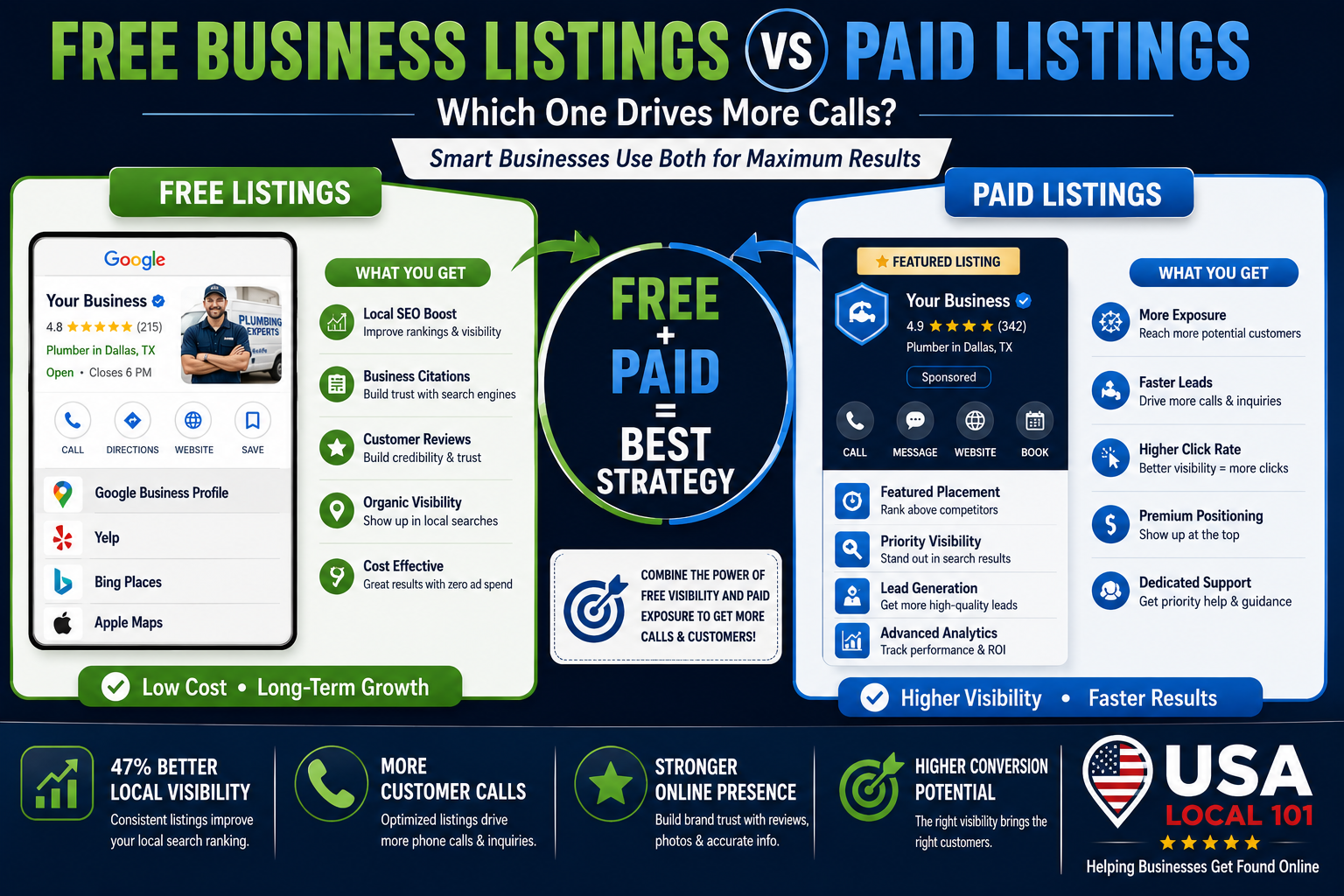
Free Business Listings vs Paid Listings
The decision on free-vs-paid listing is a decision that is considered a budget call by most business owners. It isn’t. It is a strategy call and the distinction is critical since one misstep will give your competitors a free hand to gain visibility or one misstep will eat up your marketing budget in a placement that would never have converted in the first place. Ahead of upgrading a Yelp listing or spending money on an Angi subscription or defining whether your free Google Business Profile is working well enough, you require hard numbers: what will each service actually be doing to your local search results, the number of people viewing your profile, and the number of people calling your phone. This blog provides you with those answers by type of business, by market condition, and what the data in 2026 will reveal.
What Free Business Listings Actually Give You
Free listings are not consolation prizes. On the right platforms, they are the single most powerful local SEO move a business can make and most businesses are using maybe 30% of what these profiles are capable of.
The Platforms That Matter Most
Google Business Profile is the non-negotiable starting point. It is free, decides how you will be shown in Google Search and Google Maps and directly defines whether you will be the 3-Pack or not the three results that get the most clicks and calls per local search query. On top of Google, there are Yelp, Bing Places, Apple Maps and Facebook Business Pages which all have real search weight and show your business to audiences that are not necessarily initiated to search on Google.
Complete free listings see 28% more customer calls than incomplete profiles, and strategic free citations boost local SEO rankings by 47%. These figures are provided by those businesses that utilized their free profiles as a sales instrument not as something they created once and never touched again.
What Free Listings Do for Your SEO
Whenever your business name, address and phone number (NAP) is used consistently in a reputable directory, Google feels more confident about your business. Every citation serves as a testament of confidence in the existence and dependability of your business the more you are cited in highly respected directories, the more the search engines will put their money on what you say.
The creation of 50 or more quality citations by authoritative sources is a groundbreaking local SEO strategy to directly grow visibility in the local search results and the Google Map Pack. This can be fully accomplished without any contribution of money but it needs precision. Simple differences in the formatting of your address or phone number in all directories can water down the signal and damage your rankings.
The Real Limitation of Free Listings
Free profiles come with a ceiling and that ceiling arrives faster than most business owners expect. Claiming profiles, maintaining NAP consistency across 50-plus directories, refreshing photos, managing reviews, posting updates, and tracking which platforms are actually driving calls is not a one-afternoon task. It is ongoing work that compounds when done consistently and collapses when ignored. Most businesses that rely solely on free listings aren’t losing because the platform failed them they’re losing because no one is actively managing what they claimed. In competitive markets, an unmanaged free listing isn’t neutral. It’s a liability that your optimized competitor is quietly benefiting from every single day.
What Paid Listings Actually Give You
There are paid listings on a spectrum. On the one hand, you can get upgrades on such directories as Yelp and Yellow Pages where you pay to be featured, have ads of your competitors removed off the profile, and get more analytics. On the other side of the spectrum are sites such as Angi where you directly pay on lead, not visibility. Before you spend a penny it is healthy to know what model you are purchasing into.
Priority Placement and What It’s Worth
Paid placements have advanced placement, featured placement, advanced analytics, promoted content, removal of competitor ads, and priority customer service. Practically, featured placement would imply that your listing would be at the top of all free listings in a category search within that site. For high-traffic directories where potential customers are actively comparing providers, being first on that list translates directly into more profile views and more calls.
Listings with conversion widgets (paid) have a conversion rate of 4.4% about three times that of free listings. The difference between paid and free profiles is that the former give more content, includes direct booking, call-to-action, and placement, and has a visual presentation that cannot be compared to the latter.
When Paid Listings Deliver Real ROI
The calculation of paid directory listings is all math based on the value of one new customer to your business. A small law firm invested $350 in premium directory listings across three platforms. These listings produced more than 17 new clients directly in six months, translating to over $25,000 in new business a payback of more than 7,000%.
That figure isn’t typical across every industry, but the principle holds: in high-value service businesses legal, medical, home services, financial where a single client relationship is worth thousands of dollars, paid directory placement pays for itself with one conversion. In low-margin, high-volume retail, the equation looks different.
Industry-Specific Directories Outperform General Ones for Paid Listings
Niche directories produce three times the number of leads that are qualified as compared to general platforms, but the overall reach of these directories is lower. A plumber paying for a featured listing on Angi reaches a far more targeted audience than the same budget spent on a generic business directory. Houzz home improvement, Healthgrades medical practice, Avvo law, TripAdvisor hospitality these platforms have people who are already in the buying stage to purchase that particular category, which means the leads they produce are warmer and turn quicker.
How to Get the Most From Both Without Doing It Alone
Free Listings Require More Than Setup
The businesses winning on free listings share these habits: every field in their Google Business Profile is filled out services, description, hours, photos, Q&A, and weekly posts. Their NAP is letter-for-letter identical across every directory they appear on. They collect and respond to reviews consistently, using location and service keywords naturally in their replies. They treat their profile as a living asset updating it monthly, not annually.
Businesses with complete, verified Google Business Profiles are 50% more likely to be considered for a purchase, and customers trust businesses with visual content 2.7 times more than those without photos. None of this costs money. But it costs consistent time, attention, and expertise that most business owners running an actual operation simply don’t have and that’s exactly where the gap between a listing that sits there and a listing that rings opens up.
Why Paid Listings Fail Without Professional Management
Paid placement without a fully built, actively managed profile behind it is money spent on a door that leads nowhere. The businesses that report poor ROI from paid directory listings almost always share one thing in common they paid for the position but never invested in what a searcher lands on. The profile was thin, the photos were stock, the reviews were sparse, and nobody was tracking which calls came from where. Paid visibility amplifies whatever your listing already is. If what it is, is mediocre, you’ve paid to broadcast mediocrity to the highest-intent audience in local search.
Track Every Listing Like a Campaign
Regardless of your approach, be it free or paid listing, it is important to have proper tracking done with the help of UTM parameters and conversion tracking in Google Analytics. Each of the major directories should have a specific tracking phone number. This will give you an accurate account of which platforms are being called and which ones are nothing more than space. Devoid of this data, you are making guesses and guessing on the marketing budget is how a business squanders money they could not afford to lose.
The Answer Isn’t Free vs Paid It’s Both, Done Right
The businesses receiving regular inbound calls as a result of being listed in directories are not making the distinction between the two. They have established a base of optimized free listing on all high authority sites, and they strategically spend on placements on the directories where their target consumers engage most actively and where featured placements have been shown to move the needle.
Free listing takes care of your local SEO base, the volume of your citation, and your organic appearance in search. Paid listings handle competitive separation, premium placement, and lead volume when organic alone isn’t enough. They collectively encompass the entire funnel of discovery to dial.
The difference between businesses running this system profitably and businesses running it into the ground is not information, it’s execution. Building it right, maintaining it consistently, and tracking every dollar it produces is a full-time discipline, not a weekend project. USA Local 101 manages exactly this for local businesses that are done guessing and ready to turn their directory presence into a phone that rings on schedule.
Recent Posts
Top 5 Reliable Gas Line Installation Services in Roanoke, TX

5 Best Slab Leak Detection & Repair Services in Keller, TX