
How Business Directories Improve Local SEO Rankings
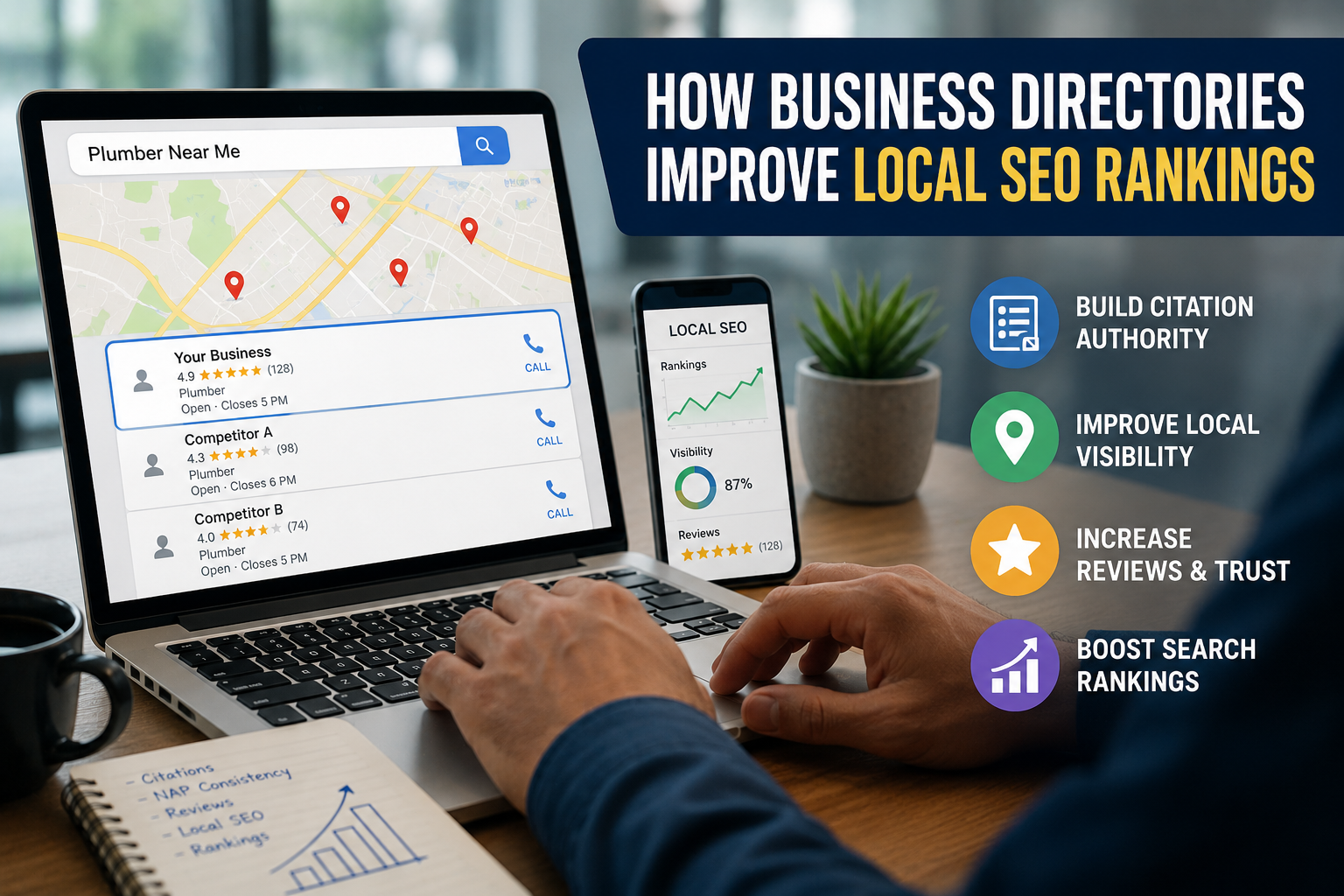
Two businesses. Both businesses are in the same city, offering the same service, and have the same quality website. One is featured in Google’s local 3-pack and receives 80% of the calls. The other is on page 2 wondering why they aren’t ranking. And the reason, most likely, is because of one thing: citation authority via business listings on directories. It’s not glamorous. It’s not a topic on marketing blogs. But it is one of the most reliable, proven elements in how Google determines which local business should be at the top of the pack and which should be at the bottom.
What Business Directories Actually Do for Local SEO
Search engines don’t only look at your site. They scour the internet for other signals that tell them your business is legitimate, that it’s where you say it is, and that it’s relevant to the search query. One of the main sources of those signals is trusted local business directory.
Each time your business is listed on a directory with a consistent NAP (Name, Address, Phone) that’s referred to as a local citation. Google cross-references these citations across platforms to build confidence in your business’s legitimacy and geographic relevance. The more accurate and prevalent your citations, the stronger Google’s confidence in your local business entity.
This isn’t speculation. The Local Search Ranking Factors study by Moz cites citations as a top-five local pack ranking factor. That’s why businesses with more citations rank higher than businesses with better web pages but fewer citations because local SEO isn’t just about on-page optimization. It’s about off-page entity verification.
The Citation Consistency Rule That Most Businesses Violate
This is how most businesses are sabotaging their local search rankings. You have “Mike’s HVAC Services LLC” as your business name on your website, “Mikes HVAC” on Yelp, and “Mike’s Heating & Cooling” on Google Business Profile. To a human, these are obviously the same business. To Google’s bot, those are three different businesses and that’s a problem called citation conflict.
Citation conflict has a measurable impact:
- It decreases your confidence level in Google’s local index, decreasing your chance to be in the local 3-pack
- It dilutes your citation authority across several unverified entity profiles, rather than strengthening a single entity profile
- It muddies the waters for data aggregators such as Data Axle, Neustar Localeze and Foursquare that provide business data to dozens of secondary directories automatically
- It lowers your Google Maps rank by telling the algorithm you’re not trustworthy
The solution is wholesale: audit every listing in every directory, audit your NAP (name, address, phone) to the point of whether you abbreviate “Street” or not, and then replace inconsistencies one at a time. Any business that undertakes this audit sees a rank improvement in 60-90 days without a single change to the website.
How Google Business Profile and Directories Work Together
Google Business Profile (GBP) is not an isolated ranking factor. It is part of a local search ecosystem and your presence in directories either enhances or diminishes your GBP authority.
When Google crawls Yelp, Bing Places, Apple Maps and niche directories and sees your business is listed with the same information on your GBP, it confirms the existence of your entity. Your business becomes a confirmed, trusted local entity in Google’s Knowledge Graph and that boosts your local pack rank.
Examples of signals from directory listings to your GBP authority include:
- Review speed and volume review sites such as Yelp and Tripadvisor feed into your online reputation signals, which feed into local pack
- Category consistency if your business category is consistent across GBP, Yelp and niche directories, Google becomes more confident in its classification
- Latitude and longitude data directories that contain your latitude and longitude coordinates, in addition to your address, contribute to your geo-relevance for local searches
Business description keywords when directory listings contain your service keywords and city names, you add more semantic relationships between these keywords and your business
These signals are not stand-alone. They are a system and the system works when your directory listings are complete, accurate and consistent
Niche and Regional Directories Carry Specific Ranking Weight
General directories like Google, Yelp, and Facebook get the most attention, but vertical directories and regional business indexes do something those platforms can’t: they establish topical authority and hyperlocal relevance simultaneously.
An electrician with a license listed on Angi, HomeAdvisor, and Houzz tells Google three specific things: this business is a home service, not just a local business. That topical relevance signal helps Google rank the business for high-intent searches like “licensed electrician near me” or “electrical panel replacement in [city].”
Regional directories, city chamber of commerce listings, local business associations, neighborhood-specific business indexes do something equally valuable: they build hyperlocal geographic authority. Google ranks local businesses on proximity, prominence and relevance. Regional directory citations directly feed the prominence and relevance components of that formula.
The strategic breakdown looks like this:
- Tier 1 (Google Business Profile, Yelp, Bing Places, Apple Maps) establish general citation authority and Google entity verification
- Tier 2 niche directories (Angi, Houzz, Avvo, Healthgrades, Zocdoc) establish vertical topical authority and capture high-intent referral traffic
- Tier 3 local directories (city business listings, chamber of commerce, local newspaper business listings) build local prominence and reputation
Data aggregators (Data Axle, Neustar Localeze, Foursquare) spread your NAP information to hundreds of lesser directories, extending citation volume
Companies that develop citations across the four tiers create a very hard-to-catch-up citation foundation that is almost impossible to rapidly increase in the short term because citation authority takes time to build.
The Role of Reviews in Directory-Driven SEO
Business directory reviews are more than just trust signals – they’re ranking signals. The Google local algorithm uses the volume, frequency, tone and keyword relevance of reviews to help rank local packs.
A company with 85 4.6-star Google reviews, backed by 40 reviews on Yelp and 25 on industry-specific directories, provides a cross-platform review presence that will be stronger in terms of social proof than businesses with reviews only on Google.
The most valuable aspect of directory reviews for SEO is review keywords. When reviews talk about the services you offer, the areas you service, or particular issues they address “fixed our furnace in North Dallas same day” this is user-generated semantic content added to your review profile. Google crawls this data and uses it to boost your ranking for those keywords. You’re benefiting from non-paid keyword optimization.
Responding to reviews adds another layer. Engaging with reviews demonstrates to Google that your profile is being actively maintained – showing Google that you have a freshness signal for your listings that helps maintain rankings over time.
What Happens When You Ignore Directory Listings
Failing to manage directory listings not only means businesses miss out on rankings opportunities they lose out. Businesses with healthy citation profiles occupy the local 3-pack that receives 44% of local search clicks, according to BrightLocal’s local search statistics. Organic results below the local pack get a fraction of that traffic.
Beyond affecting rankings, unclaimed or poorly managed listings are a liability: many directories allow anyone to make suggestions, so your address, phone number or category can change without your permission. Other companies have lost thousands of calls when a competitor or data error changed their phone number on a popular directory and they didn’t catch it for months.
Conclusion
The 2026 local citations leaders didn’t create their authority overnight. They did it carefully with claimed listings, consistent NAP (name, address, phone number) data, the right vertical niche directories for their business, consistent reviews, and regular profile updates with fresh photos, hours and service descriptions.
This is a local SEO long game. Unlike paid ads that disappear the moment the budget stops, a strong directory presence compounds. Each new citation, each new review, each consistent NAP signal adds to a foundation that becomes more competitive over time and harder for new entrants to displace quickly.
For local businesses that want to get it right from the beginning, USA Local 101 offers a structured directory platform that can help build your local citation authority, boost your local search visibility, and put your business in front of customers when they’re searching for the products and services you offer.
Recent Posts
Top 5 Reliable Gas Line Installation Services in Roanoke, TX
5 Best Slab Leak Detection & Repair Services in Keller, TX