

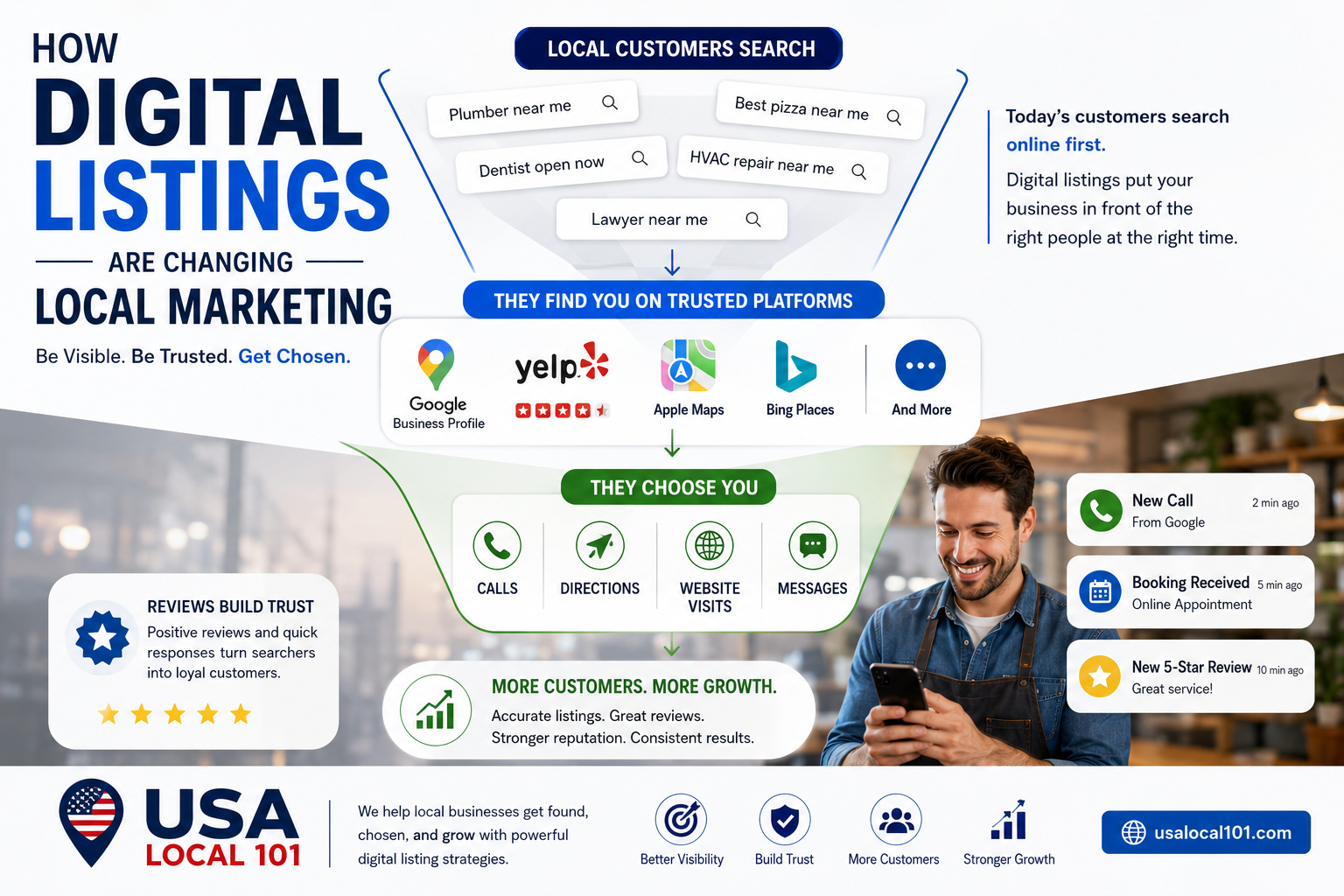
How Digital Listings Are Changing Local Marketing
Forty-six percent of all Google searches have local intent, yet nearly 56% of local businesses haven’t claimed their Google Business Profile. That gap isn’t just a missed opportunity. That’s a gradual loss of income that can snowball, day by day, as a business remains unseen online.
Local marketing was once a Yellow Pages ad, a flyer on a community board and word-of-mouth. That world is gone. Your competitor is standing outside their shop today because the customer who came in looked at them not because of a billboard or a radio spot but because a search engine provided complete and accurate business information and it was optimized to do so all in less than three seconds.
Most local business owners don’t fully realize that digital listings are not just a digital version of an entry in the phone book. They are alive, algorithm-powered, review-driven assets that directly impact purchasing decisions, local search rankings and even credibility signals that Google shows for your business.
What a Digital Listing Actually Does in 2026
When your business is listed on the Google, Yelp, Bing Places, Apple Maps and data aggregators such as Data Axle and Foursquare, it puts your business in the decision making stage. When someone searches “best HVAC repair near me” at 9 PM on a Tuesday, they’re not browsing. They’re choosing.
- Each directory has consistency in the name, address, and phone number of your business helps search engines understand that you are legitimate and trustworthy.
- Citation fragmentation means that “Pete’s Auto” on Google is not the same as “Pete’s Auto Shop LLC” on Yelp and hurts your map pack rankings.
- A 2023 BrightLocal study found businesses with consistent listings across 50+ directories ranked 23% higher in Google’s local 3-pack than those with fewer or inconsistent citations
- Profiles that aren’t complete incomplete hours, no pictures, no business description imply that you’re neglecting your profile to Google’s algorithm and to customers reading your profile at midnight.
The business which has a full listing, accurate data, recent photos, 4.6 stars and owners respond to the reviews wins the call. Every time.
The Behavior Shift That Made Listings Critical
The consumer has not only gone online, they’ve gone hyper local and intent driven. Near me’ queries have seen a more than 500% increase in a 5-year period and this trend is not slowing down. Bakeries, plumbers, nail salons, chiropractors, etc. are all searched for just like directions, with urgency, and no room for out of date information.
The impact on businesses is deadly. A wrong phone number in a listing doesn’t just cost you one call. It costs you trust. If a customer calls a disconnected line, he or she does not call back he or she skips to the next result. Outdated business hours listed online cause real-world frustration, and frustrated customers leave negative reviews that follow your business for years.
Google’s local algorithm takes three important factors into account: relevance, distance, and prominence. Of these, the one that comes the closest to being directly affected by your digital listings ecosystem is prominence. Search volume, search velocity, local directories backlinks and overall online thoroughness are the factors that contribute to prominence. A business that has 200 reviews and a fully-featured listing is much more noticeable than one that has 12 reviews and a barebones listing, even if the barebones business has been around for decades.
How Listings Are Reshaping Specific Industries
Home Services
A plumber in Phoenix competing for emergency plumbing searches lives or dies by listing quality. When your customer is looking for a plumber at midnight seeking a burst pipe, they are not reading blog posts, they are clicking on the first listing that has a phone number to call, a service area and some reviews to make them feel like they can trust you.
- Service area listings within Google Business Profile allow contractors to list all the zip codes they serve, so that businesses that complete this right will lure leads within 30 miles of them and not just the front door.
- The Local Viking 2023 tracking data shows that contractors with fully-optimized profiles get three times as many calls as those with only partially-optimized profiles.
- Response time placed prominently on Google profiles will affect click-through rates; profiles that indicate a typical response time of less than an hour have measurably higher click-through rates
Restaurants
Menu integration in Google Business Profiles revolutionized the restaurant discovery game. Before people even go to a restaurant’s website, they are checking the cuisine, price and ambience.
- Restaurants with 400+ photos in the listing get 520% more direction requests than restaurants with less than 10 photos in the listing.
- Availability of price range indicators and dietary characteristic tags (vegan friendly, gluten-free options) within a listing helps pre-filter customers, minimizing walk-in grievances and boosting satisfaction.
- Profiles with new posts and offers on a weekly basis rank better in local discovery than profiles that are not updated.
Medical and Healthcare Practices
In the case of healthcare, there are some specific trust issues. Patients are putting a finer point on scrutiny than the person looking for a coffee shop.
- Listing insurance acceptance, specialties, and provider credentials removes friction and directly lifts appointment conversion rates
- Practices that have proven Google profiles and consistent citations on healthcare directories such as Healthgrades and Zocdoc do better with condition-related local search.
- If a provider doesn’t state telehealth availability in their profiles, or if the information is incorrect, it could be the reason why practices are losing out on a significant portion of their patient base that is looking for a provider who fits their criteria.
Reviews Are the New Word-of-Mouth Except They Scale
Five people were reached by traditional word of mouth. A Google review will be seen by anyone who searches for your business category in your location – forever. The listings ecosystem is the most trusted form of social proof for local businesses and online reviews is where they reside.
The review management responding to both positive and negative feedback is now apparent in the way that Google rates your customer interaction. The algorithm sees businesses that respond to 100% of their reviews as more authoritative and more trustworthy by customers. A well-crafted, professional and responsible response to a negative review is more likely to turn browsers into customers than a string of 5-star reviews without any actions by the owner.
It is important to review velocity also. Twenty reviews were received with more than three months signals which indicated that the business is healthy. Twenty reviews had more than three years signal and it showed stagnation. Strategies like post-purchase email follow-ups, QR codes at checkout, and staff-prompted review requests have become standard practice in businesses that take local search seriously.
The Listings Data Infrastructure Most Businesses Ignore
Behind every visible listing is a data infrastructure most business owners have never thought about. Your business information is sent to hundreds of downstream directories, GPS systems and voice search databases, through data aggregator services, specifically Neustar Localeze, Data Axle, Foursquare and Acxiom.
- If your data is incorrect at the aggregator level the whole chain is automatically affected and correcting it on Google won’t do a thing.
- Voice search optimization isn’t based on your website, but on aggregator databases – a business that doesn’t exist in aggregator databases will not respond to voice search queries.
- Data drift is a reality and third party sources regularly update with outdated data—a listing management audit should take place quarterly, not annually.
To correct this, you need to claim all of your biggest listings, make sure to keep your NAP uniform and submit corrections to all four major aggregators, and then monitor regularly. It’s not a one-time task.
What This Means for Local Marketing Strategy
Local marketing budgets once used exclusively for print advertising, local TV spots, and direct mail are being shifted to digital presence management and it’s measurable– unlike traditional advertising. This new feature allows businesses to monitor the number of views, requests for directions, call clicks, and website visits directly on their Google Business Profile dashboard.
The businesses winning in local markets right now treat their digital listings as living assets, not one-time setups. They update seasonally, review response is consistent, photos added on a regular basis, and a quarterly citation health audit. Those who view listings as a checkbox are gradually falling behind those companies who realize that local search is a long game to play, one that is based on data accuracy, engagement and trust.
Conclusion
Digital listings have quietly become the most powerful tool in local marketing not because the technology is flashy, but because customers have made them the first stop in every buying decision. When a business has accurate listings across directories, they receive consistent reviews, and control their listing data, it is not only available, it’s credible. This credibility builds over time to lead to rankings, calls, foot traffic and revenue that no print ad can ever duplicate. When you’re prepared to get that foundation right, USA Local 101 can help you get your business in front of your next customer, where they are already looking.
Recent Posts
Top 5 Reliable Gas Line Installation Services in Roanoke, TX
5 Best Slab Leak Detection & Repair Services in Keller, TX