
How to Verify If a Business Listing Is Legit
You nearly hired a non-existent plumber. When you Googled them, their Business Profile was impressive: five stars, a local area code, a website and even photos of past work. You called the phone number, they answered and took a deposit and disappeared. This isn’t a rare horror story. The Federal Trade Commission reported over 2.6 million fraud cases in 2023, and a significant chunk involved fake or manipulated local business listings that fooled ordinary consumers searching for real services nearby. So before you click the button, schedule the appointment or or unlock your wallet, here’s how to check if a business listing is real or not.
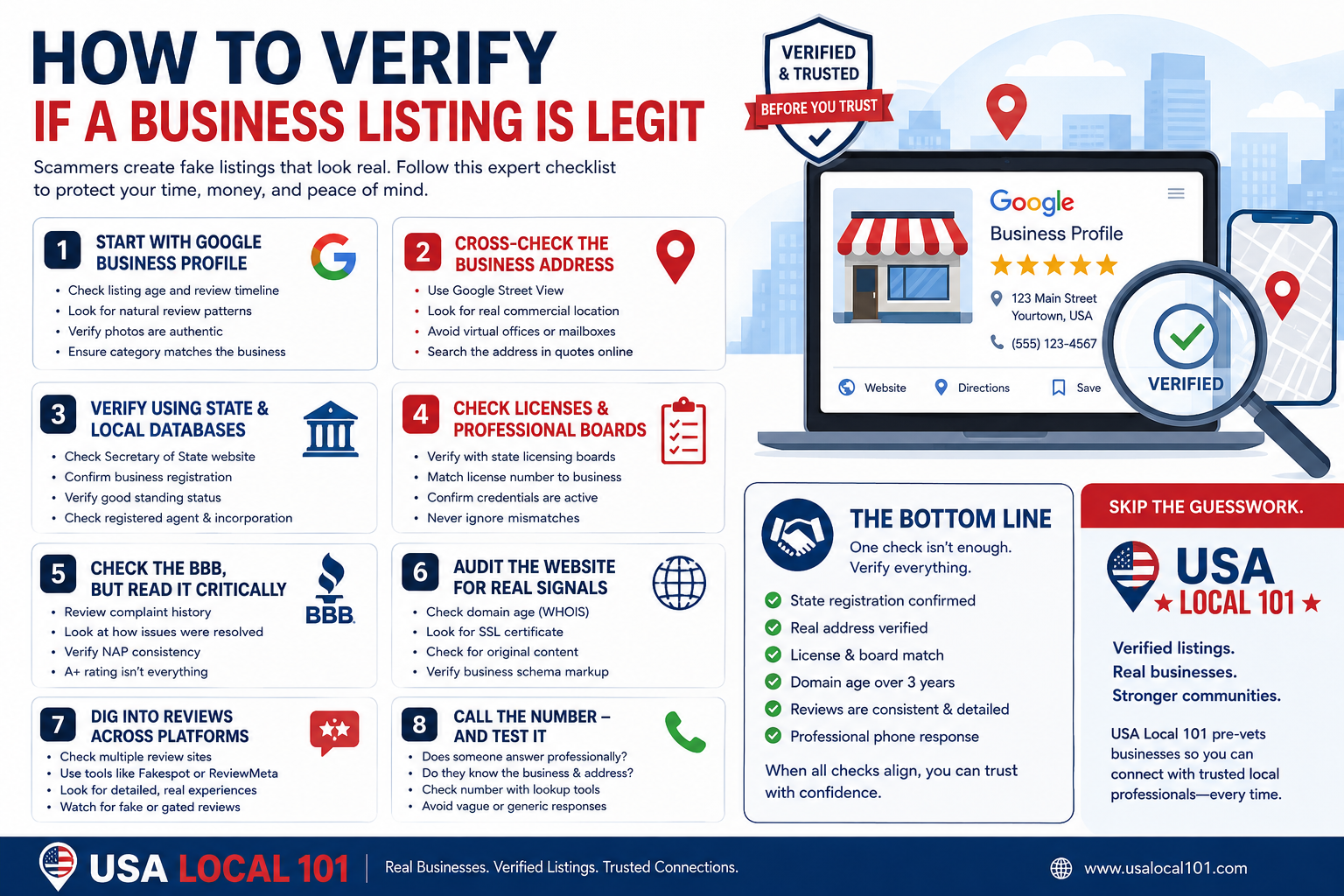
Start With the Google Business Profile But Don’t Stop There
Google Business Profile (GBP) is how most of us are searching for a local business in the map pack or sidebar. It feels authoritative, and that’s precisely why fraudsters exploit it. It’s easy for anyone to claim or set up a listing on Google Maps.
What to check inside the profile:
- Age of listing: A listing created last week for a business that claims “20 years of experience” should be avoided. The oldest review timestamp tells you more than the business description ever will.
- Review patterns: Real businesses have reviews spread over time with a normal distribution of ratings. Fraudulent ones have a bunch of five-star reviews in a few days with generic comments like “great service” and no detail whatsoever.
- Photo authenticity: Legitimate businesses post photos of worksites, employees and office locations. If they reverse-image search (right-click → “Search image with Google”) to other unrelated sites or are obviously stock photos, be wary.
- Category consistency: A business listed under “pediatric dentist” whose reviews mention plumbing work has mismatched signals that suggest listing manipulation.
Cross-Check the Business Address Using Street View and Satellite
A real address is a great indicator of trust in a business listing. But don’t just read it look at it.
Search in Google Street View for the address. A commercial address? A professional office? Or an empty lot, a private residence without signage, or a virtual office address that is shared with scores of other “companies”?
Virtual office scams are common. Scammers lease a mailbox at a co-working space, a mailbox centre, or other mail forwarding service and use that address to seem more local. If the Google Street View reveals a UPS Store, a Regus office or a mailbox service with no branding that’s worth a closer look.
You can verify the address with USPS address verification tools, or search Google using the address in quotes. If 15 businesses are located at the same address, that’s a listing scam.
Verify the Business Through State and Local Databases
It’s the most important step, and the one that most people overlook.
All legal businesses in the U.S. must be registered with the Secretary of State in their state of incorporation. The majority of states offer free search engines where you can search for a business by name and verify whether the business is a registered legal entity, what its registered agent is, when it was incorporated and whether it is in good standing (meaning it hasn’t been dissolved).
If someone claims to run “Harrison’s Roofing LLC” but there’s no LLC by that name in the state database or the registration was dissolved two years ago that’s not a technicality. That’s fraud exposure.
For licensed trades, check these specific boards:
- Contractors and builders → your state’s Contractor Licensing Board
- Electricians and plumbers → state Department of Labor or Trade Licensing Division
- HVAC technicians → EPA Section 608 certification + state licensing portal
- Real estate agents → state Real Estate Commission database
- Financial advisors → FINRA BrokerCheck or SEC’s Investment Adviser Public Disclosure
If their license number doesn’t match the name on the listing, walk away immediately.
Check the BBB, But Read It Critically
The Better Business Bureau is a useful tool, but it requires some nuance. The fact that a company has an A+ rating does not necessarily indicate that it is trustworthy BBB accreditation is a fee, so there are legitimate businesses that do not choose to be accredited, and legitimate businesses that do pay the fee.
What you are in search of on the BBB listing is the history of complaints, the trend of complaints and above all how the complaints were solved. An 12 complaint unanswered company regarding not doing work or not giving refunds tells a far better story than its star rating.
Also take note of whether the business address and phone number on the BBB profile is what is on their Google profile and site. Disagreement in NAP data (Name, Address, Phone) between directories is a good sign of a listing that is not well maintained or has been newly created.
Audit the Website for Real Business Signals
If the business has a website, run it through a quick technical audit not just a visual check.
Use these tools and what to look for:
- WHOIS lookup (who.is or whois.domaintools.com) Check when the domain was registered. A business claiming 10 years of experience but whose domain is eight months old has a story to explain.
- SSL certificate The padlock icon is baseline. Its absence on a business collecting payments is disqualifying.
- Plagiarism checker Run a few sentences from their service pages through a checker. Fake business sites frequently copy descriptions word-for-word from legitimate competitors.
- Google’s Rich Results Test Shows whether the site has local business schema markup properly tagging its name, address, and phone a sign of professional site maintenance.
- About page depth Real businesses name their staff, show real photos, and describe their history with specifics. A vague “we’ve been serving customers since 2005” with no names attached is a hollow signal.
Dig Into Reviews Across Multiple Platforms
Always do not trust one source of reviews. One can bombard his or her Google reviews with fake accounts and brutal commentary on Yelp, Trustpilot, Houzz, Angi, or the BBB.
Check Fakespot or ReviewMeta to verify the authenticity of reviews. In the case of service businesses, a reviewer profile that has a single review, no photo, and a generic name who has reviewed only this one business is suspicious by definition.
Confirmed reviewers refer to details name of the technician, kind of work, a detail of the job. Review farms generate indistinct, fungible compliments. Look for that texture.
Also note review gating when all the negative reviews receive a defensive response by the owner, or when a forum discussion mentions that their negative reviews have been flagged and deleted, that is indicative of online reputation management by manipulation being in effect.
Call the Number And Test It
Pick up the phone. Dial the number listed and listen to the way it is answered. Will he/she reply with the name of the business? Are they aware of the address? Do they offer a physical venue in which you can visit?
Scam operations are known to use VoIP numbers and call forwarding services to pretend to be local. Enter the phone number in Truecaller, NumLookup, or Whitepages to determine whether the phone number belongs to an actual business or is spam.
When the number goes on and on, to a generic voicemail, or when the answering person cannot answer simple questions about the business, then stop.
The Bottom Line
There is no foolproof verification step. An advanced counterfeit listing will pass one or two checks. What it nearly never does is to pass them all together.
State registration confirmed. Checked on Street View. Board database equals license number. Domain is more than 3 years old. Reviews show consistent detail and span over time. Professionally answered the phone with appropriate business name. That chain of verification is what separates a real local business from a fabricated one.
When you need a reliable, verified local business listing that pre-vets their listings, and ensures their NAP is accurately represented across the internet, USA Local 101 is designed specifically to do that very thing to connect consumers with real and verified businesses in their communities so that they will never have to go through this checklist again and wonder whether the company on the other side of the phone actually exists.
Recent Posts
Top 5 Reliable Gas Line Installation Services in Roanoke, TX
5 Best Slab Leak Detection & Repair Services in Keller, TX