
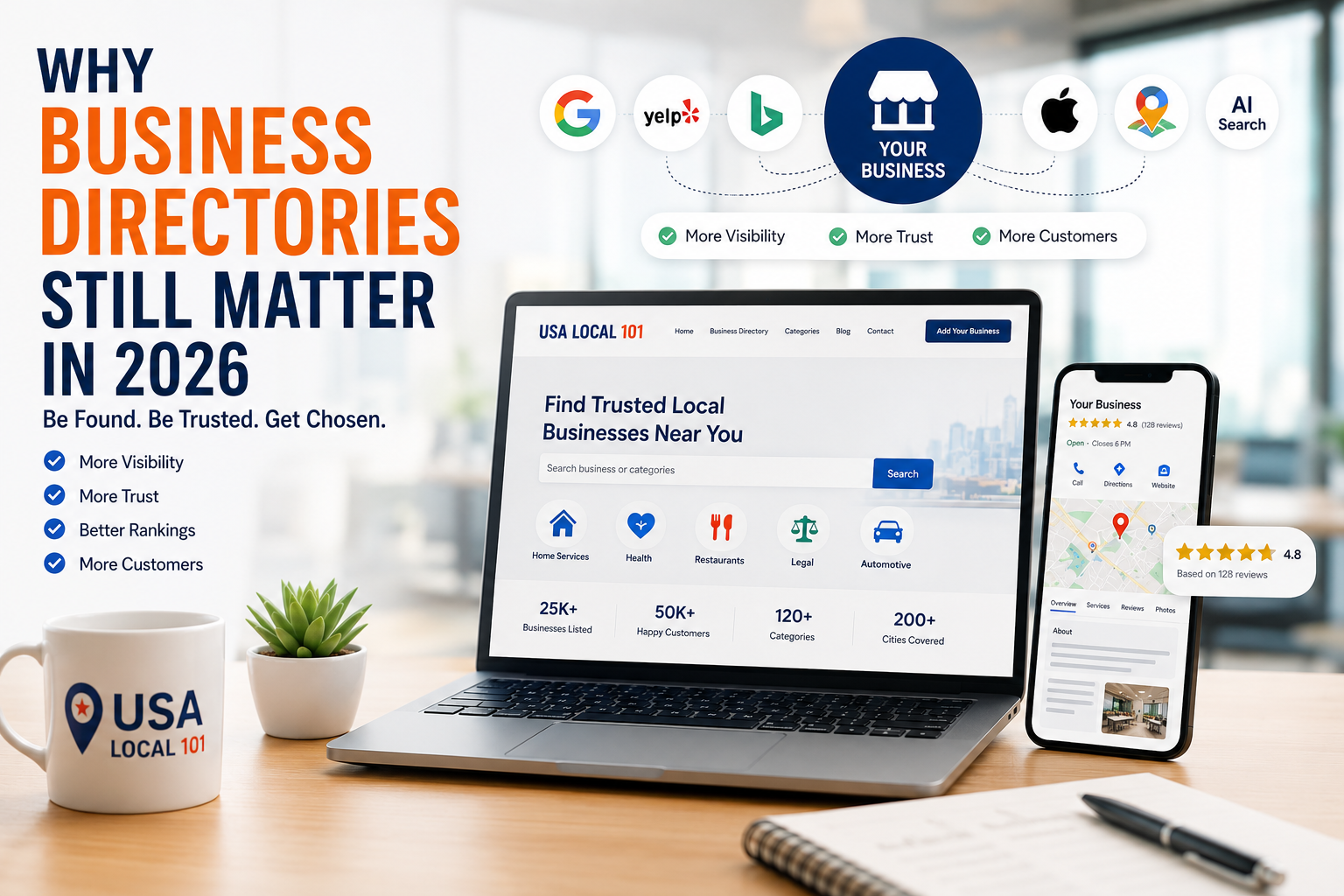
Why Business Directories Still Matter in 2026
Your main competitor hasn’t advertised this month. No sponsored posts, no google ads, no marketing emails – but their phone is still ringing. People are finding them on Yelp, on their industry-specific sites, on local yellow pages you’ve never heard about. They’re popping up in searches via voice, searches via AI and searches via the Google 3-pack local search, time and again, predictably, without paying a cent. It’s not money. It’s not a better product. It’s an organized online presence centred around something most businesses don’t care about: business directories. And it’s why that’s still, more than ever, important in 2026.
The Visibility Problem Every Small Business Faces
The vast majority of small and mid-sized businesses invest in short-term digital marketing strategies, sponsored Instagram posts, Google advertisements, stand-alone promotions and see a return on those investments disappear as soon as they stop spending. They need a foundation: they need listings that are persistent, indexed, and authoritative and that work 24/7 regardless of their monthly ad budget.
USA Business directories address a very real, under-serviced type of problem: search entry point discoverability. If you’re looking for an Austin, Texas-area plumber, you might find it in Google’s local pack, but you might also get it in Yelp, Angi, or a local business index. If you’re only in one place, in this case Google, you’re not in any place. BrightLocal’s 2025 Local Consumer Review Survey reveals that more than 76% of consumers use multiple platforms to find local businesses. Directories are those platforms.
How Business Directories Actually Drive Traffic in 2026
Here’s the new deal: directories are no longer yellow pages. Today’s local business directories are data aggregators that provide information to:
- Digital assistants such as Siri, Alexa and Google Assistant
- Personal AI assistants like Perplexity and ChatGPT’s web browser
- Geolocation services that source aggregated data
- Yelp and other review sites that aggregate reputation scores
When your NAP (Name, Address, Phone number) data is accurately and consistently listed across directories such as Google Business Profile, Yelp, Bing Places, Apple Maps and other industry-specific directories, your business is perceived as more reputable by search engines. This impacts local search engine optimization (local SEO), not accidentally, but explicitly, via a ranking factor Google calls citation consistency.
A Phoenix home services business that ensures accurate listings across 20+ directories not only receives referrals from those directories. They also get a ranking boost in Google’s organic search results thanks to a greater authority for the entity (business name).
The Trust Architecture Behind Directory Listings
There’s a psychological layer here that most marketing conversations skip entirely. When a potential customer searches for you in a well-known directory (and particularly with verified reviews), you’ve already cleared the first level of trust before a potential customer clicks through to your site.
Third-party validation is more persuasive than self-promotion. Anything can be said on a business website. But a business listing with 47 reviews, an address, business hours and photos says: this business is legitimate, and it’s active and accountable.
That’s where E-E-A-T (Experience, Expertise, Authoritativeness, Trustworthiness) the model Google uses to assess content and business authoritativeness, comes into play. Listing your business on a directory adds to authoritativeness and trustworthiness by establishing a third-party record of your business and reputation. For industries like legal services, healthcare, financial advising, and home repair, this trust architecture isn’t optional , it’s the difference between a phone that rings and one that doesn’t.
Niche Directories Outperform General Ones in Specific Verticals
Not all directories are created equal. If you’re a contractor or interior designer, Houzz is more important than Yelp. Avvo is essential for attorneys. Healthgrades and Zocdoc are key in the medical field. TripAdvisor still moves the needle for restaurants and hospitality.
If you’re on the right industry specific directory, you’re putting your business in front of consumers who are in a buying mood , they’re not just looking, they’re ready to buy something in your particular category. This is a very different market to a passive consumer.
The big mistake most businesses make:
- Generic directories (Google, Yelp, Bing) increase overall citation authority and search engine trust
- Niche directories (Houzz, Avvo, Healthgrades) drive high-intent referral traffic from pre-qualified visitors
- Local and city directories (local business listings, chamber of commerce) boost local SEO and local trust
The key to a successful directory strategy is having all three. Businesses that understand this aren’t spending more , they’re spending smarter.
The Real Cost of Incomplete or Inconsistent Listings
An incorrect phone number on Yelp. An outdated address on Bing Places. A business name that’s a bit different on three sites. These aren’t just annoyances, but are Google penalties and conversion stops.
This muddies the waters for search engine bots and depresses your confidence ranking in Google’s local index. This directly dampens your Google Maps listing and your chance of being part of the local 3-pack , the three businesses above the organic listings and receiving the bulk of local search clicks.
From the consumer’s perspective, a customer who comes to your site and sees inconsistent information about your location or operating hours doesn’t pick up the phone. They move on. Friction kills conversions, and directory inconsistency creates friction before a customer ever reaches you.
Companies that review their listings and ensure consistency say they see improvements in:
- Click-through rates from Google’s local results
- Phone calls and driving directions from Google Business Profile
- Number of reviews, because verified listings help customers leave reviews
- Organic search rankings for location-based keywords
Why Directories Remain Resilient Against Algorithm Changes
In the last 36 months, Google has introduced over 30 core algorithm updates. Social media has made organic reach so much harder that a business with 50,000 followers can expect to reach only 1,500 people with a post. Advertising has grown more expensive as demand for ad space grows.
By comparison, business directories are immune to these developments. Your listing on a high-authority directory doesn’t fall into the abyss of Google’s algorithmic changes if your listing is well maintained, in many cases the directory itself will be ranked on the first page, taking your listing with it. You’re effectively piggy-backing off the authority of the site.
This is known as barnacle SEO or “hitchhiking” on high authority sites. It’s not a black hat tactic. It’s a proven, lasting strategy that’s worked for more than a decade and is likely to continue to work.
What a Strong Directory Presence Looks Like in Practice
A business that takes directories seriously in 2026 isn’t just “claiming their Google listing.” They’re establishing a multi-platform local presence with:
- Complete profiles including a description of their business, categories of services, photos and hours of operation
- Accurate NAP data consistent across all platforms, no inconsistencies, no errors
- Managing reviews: responding, getting reviews from satisfied customers, handling negative reviews
- Seasonal changes in hours, new services, special offers, location changes
- Presence on horizontal (Google, Yelp, Facebook) and vertical (industry specific) review sites
This isn’t passive maintenance. It’s an ongoing local digital marketing strategy. Every new review, every updated photo, every consistent citation makes the overall profile stronger and more competitive.
The Bottom Line
Business directories are not a bygone part of the pre-social media world. They’re a critical part of local digital presence that helps your SEO, establishes trust with customers, and delivers leads you can track and measure , without the risk of algorithmic changes or the expense of paid advertising. The local winners of 2026 aren’t ones with the highest ad spend. They’re the ones with the most consistent, complete and trustworthy presence online – and directories are a part of that.
If you’re looking to build or clean up that presence, USA Local 101 is a business directory built specifically to help local businesses get found by the right customers in the right markets , with the structured visibility that actually converts.
Recent Posts
Top 5 Reliable Gas Line Installation Services in Roanoke, TX
5 Best Slab Leak Detection & Repair Services in Keller, TX